“The Cottage” at 7 Lee Street, Mittagong
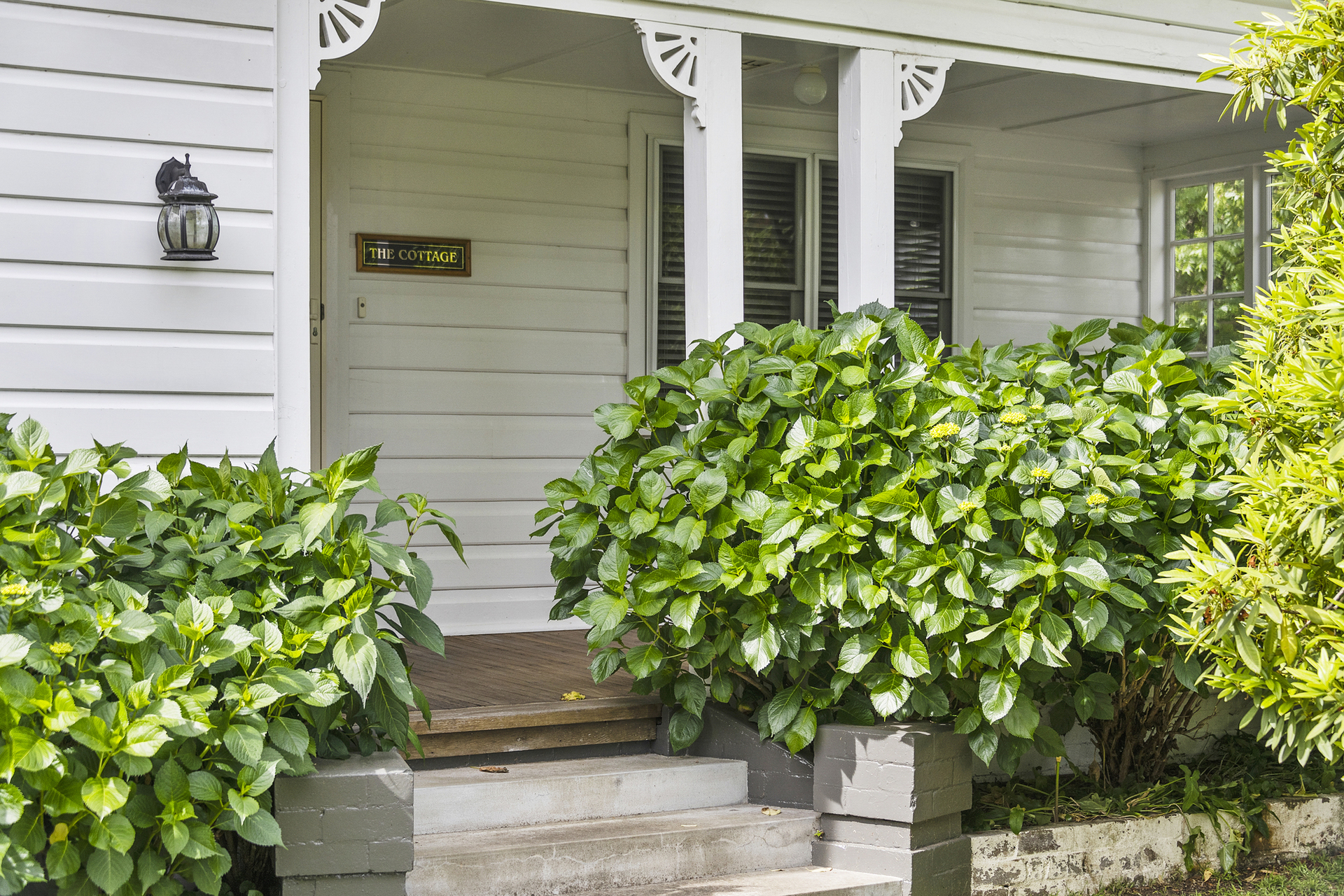
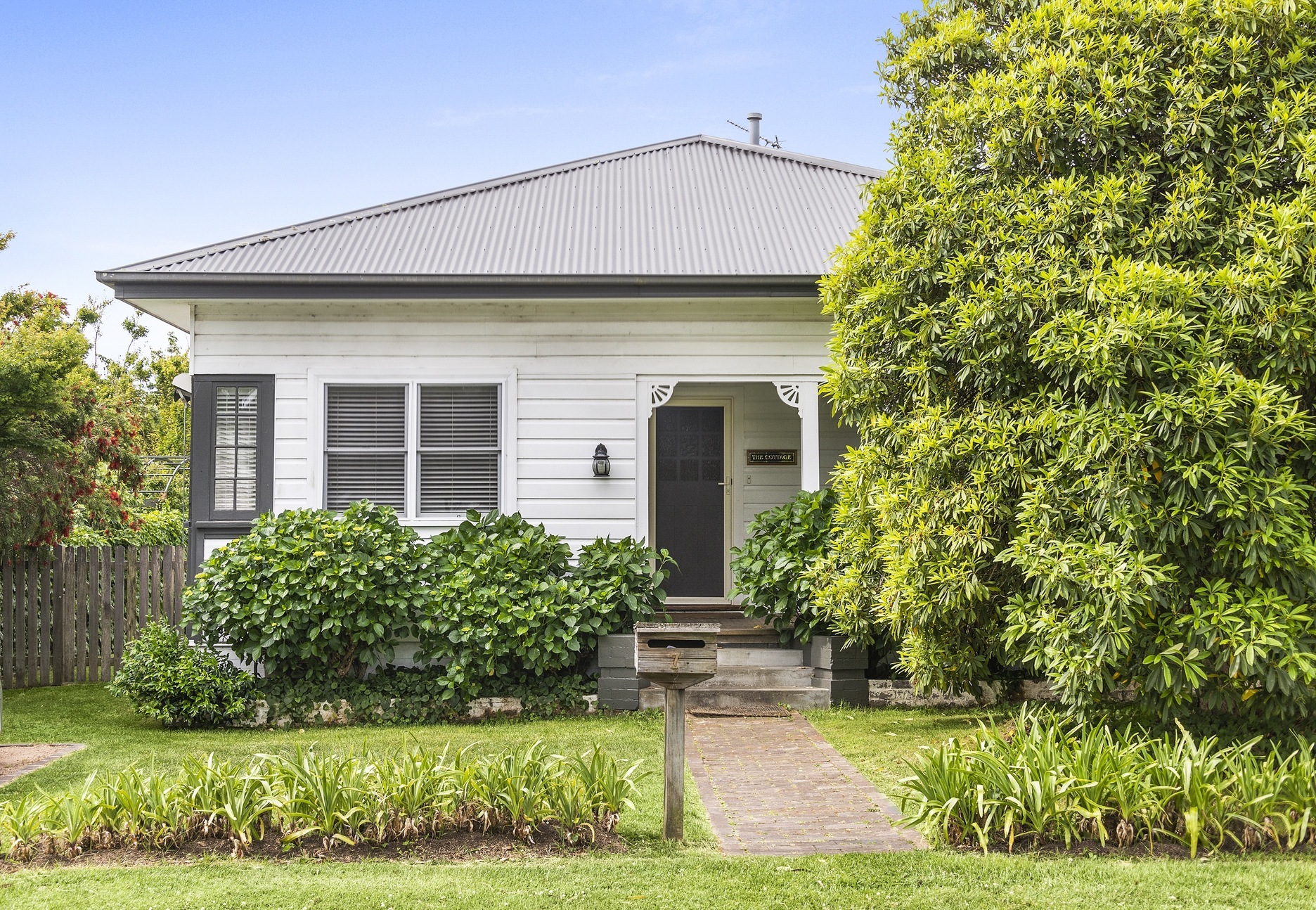
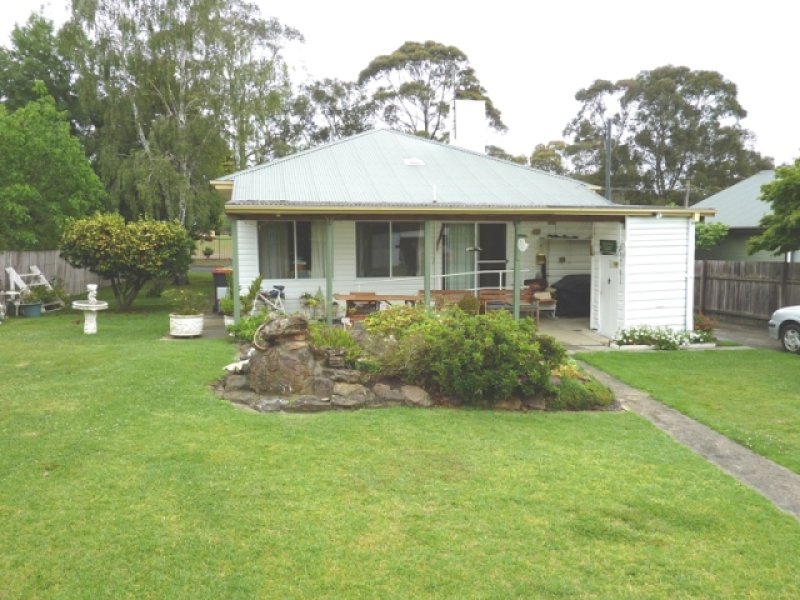
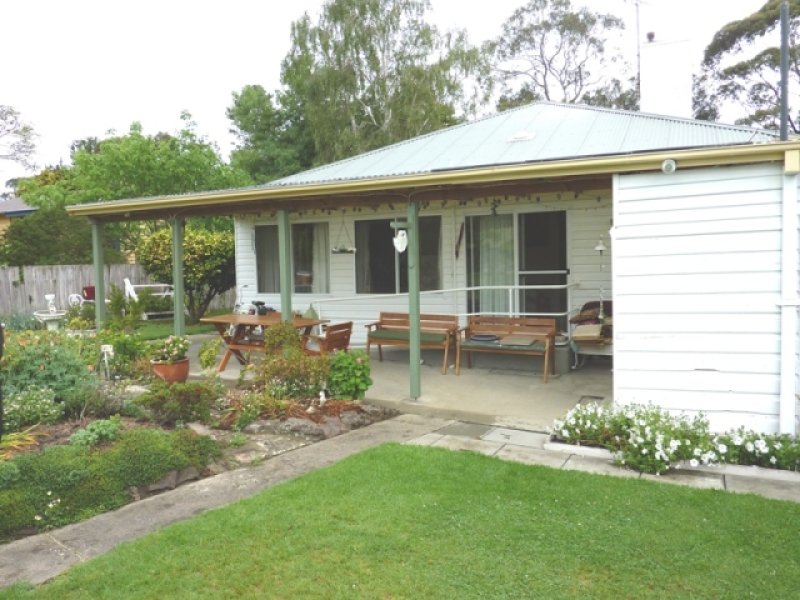
Near Lake Alexandra in Mittagong stands a weatherboard home with a nameplate by its front door: “The Cottage”. Its story reaches back through generations of owners to the land’s early connection with the Fitzroy Iron Works.
Location
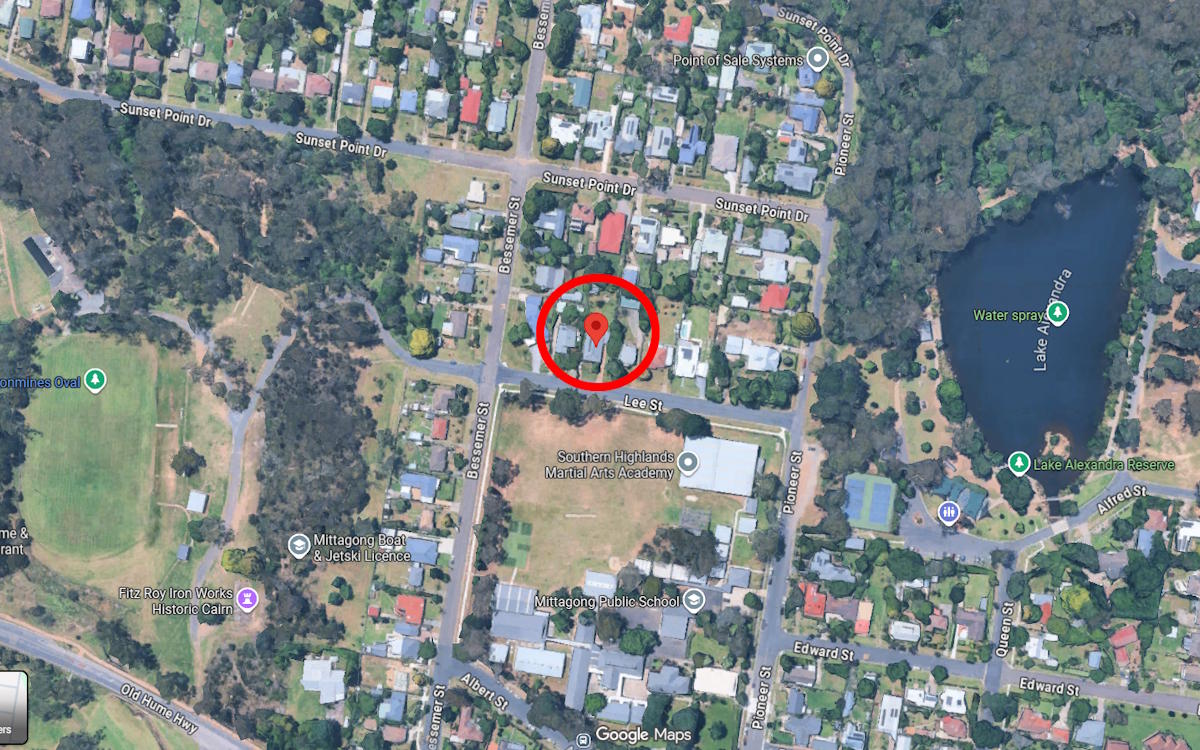
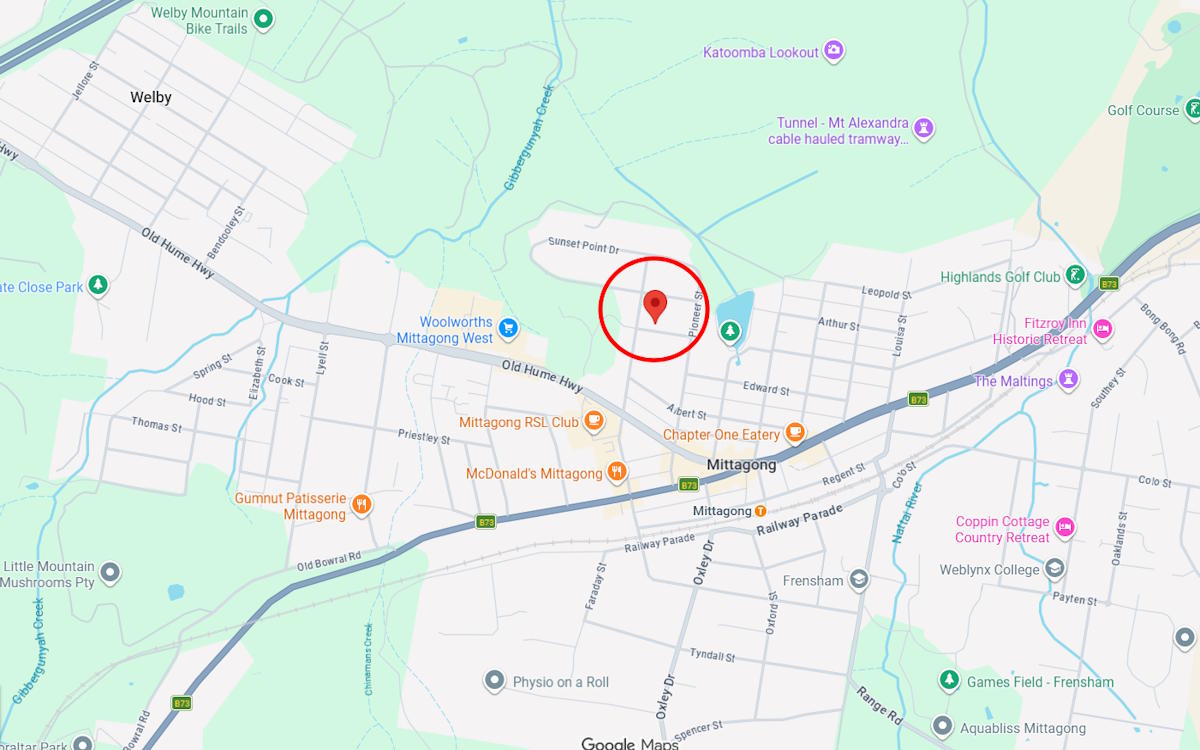
The Cottage is at 7 Lee Street, Mittagong, opposite parkland and a short distance from Lake Alexandra.
Ownership Chain
- 1864-1866Crown → Fitzroy Iron Works Company Limited
Long before there was a house or a Lee Street, this land was part of Mittagong’s ironworks story. In 1866 the Fitzroy Iron Works Company received a Crown grant for 320 acres, paying £640 for a mining purchase. Decades later, a small part of that much larger holding would become the block at 7 Lee Street.
The works had begun smelting local iron ore commercially in 1848, making them a pioneering Australian industrial venture. By the time of the land grant, they were already an established part of the district. Coal mines, quarries, brickmaking and a tramway supported the ironworks, while a new blast furnace was intended to turn local ore into iron on a much larger scale. Its early attempts were troubled, but after alterations the furnace produced about 2,394 tons of pig iron before it was shut down in January 1866. The company’s investors included John Frazer, who would later acquire the land himself.[42]
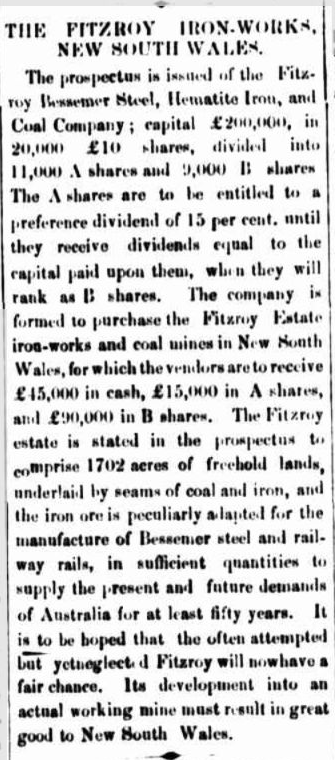
At a shareholders’ meeting in January 1866, the directors described a busy works: pig iron was being stockpiled, a coal shaft was being sunk, and new furnaces and rolling equipment were being prepared. They also looked forward to an arrangement with the engineering firm P. N. Russell & Co., hoping its experience would help the enterprise grow.[43]
The company also helped shape the town growing around its works. In 1864 its directors planned New Sheffield, with streets, building blocks and a site set aside for a Wesleyan church. Land was offered for sale the following year, as the company sought funds for its ventures. The works continued to face technical and financial difficulties, and the company resolved to wind up in 1869.[42]
For a broader history of the ironworks, including its people, machinery and later years, see Fitzroy Iron Works on Wikipedia.[46]
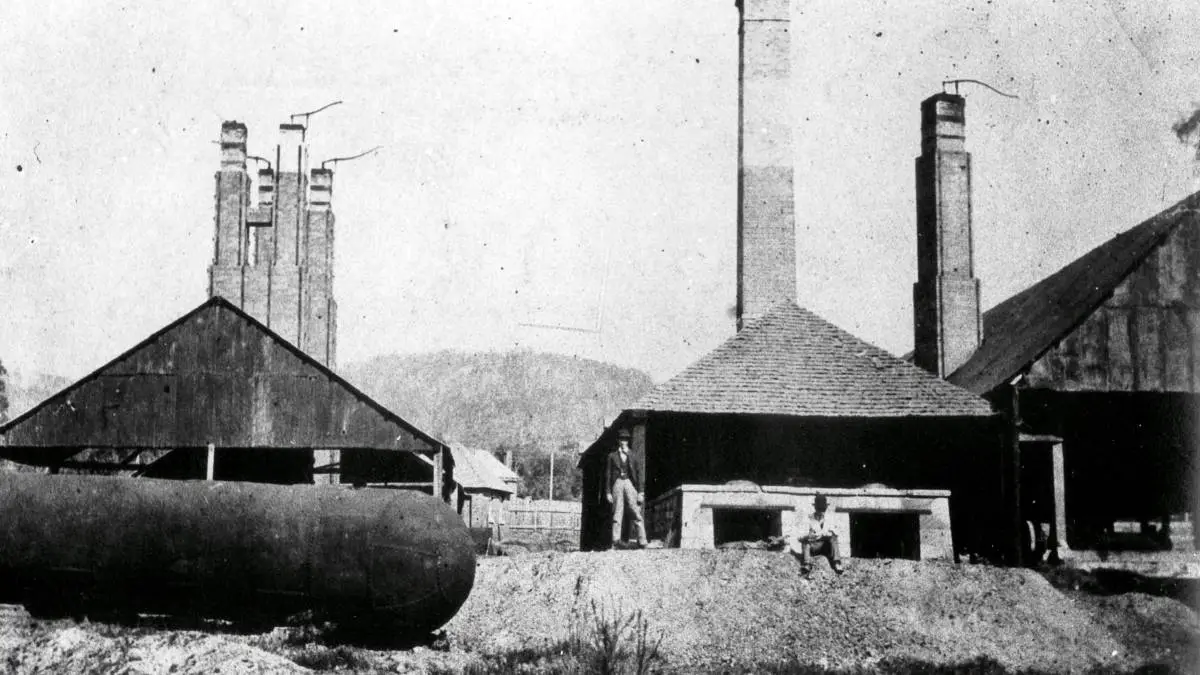
Fitzroy Iron Works Source: Berrima District Historical Society [52] 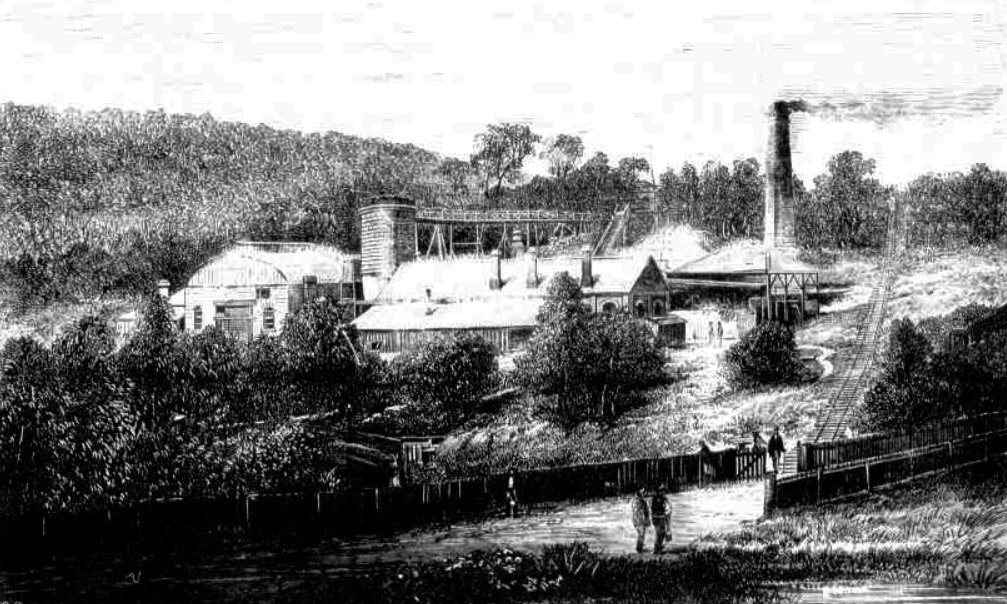
Blast furnace and foundry, illustrated in 1873 Source: Illustrated Adelaide Post, via Wikimedia Commons [47] 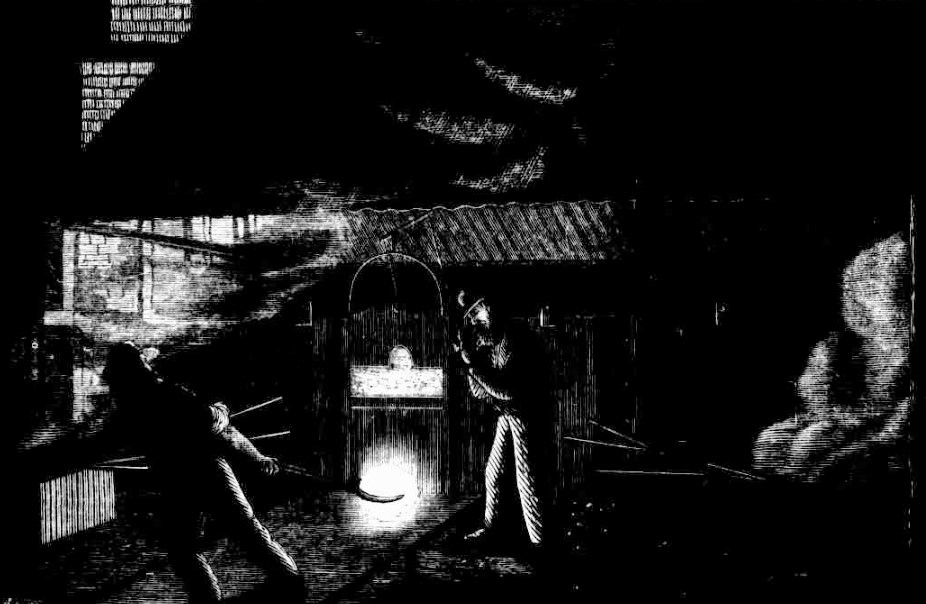
Workers at the puddling furnace, 1869 Source: Illustrated Sydney News, via Wikimedia Commons [48] 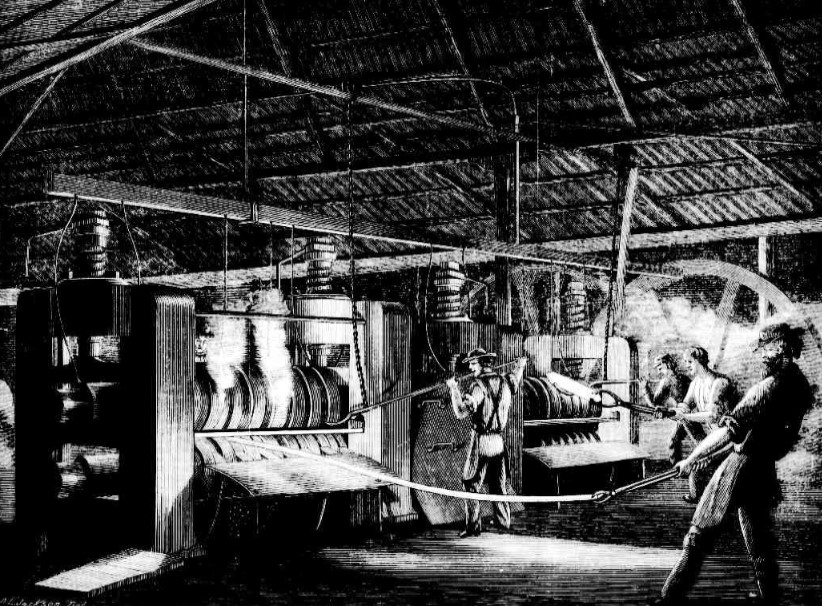
The ironworks rolling mill, 1869 Source: Illustrated Sydney News, via Wikimedia Commons [49] 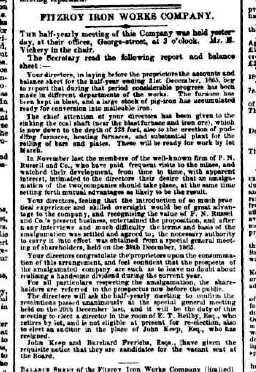
Fitzroy Iron Works company meeting, 1866 Source: Trove [43] 
History of the Fitz Roy Iron Works Source: Ray Christison, High Ground Consulting [42] 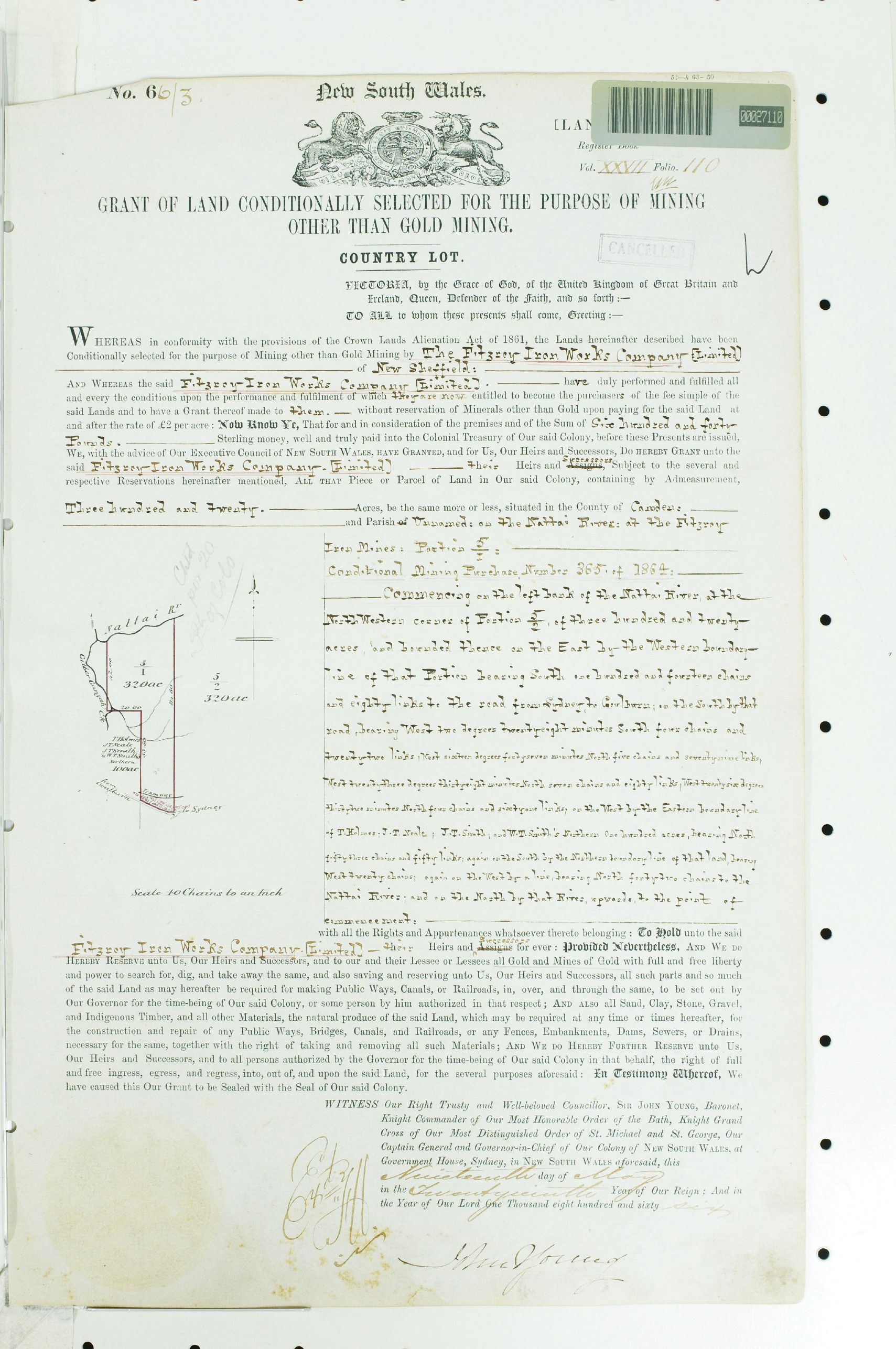
Crown grant CT27/110 Source: NSW Land Registry Services [3] 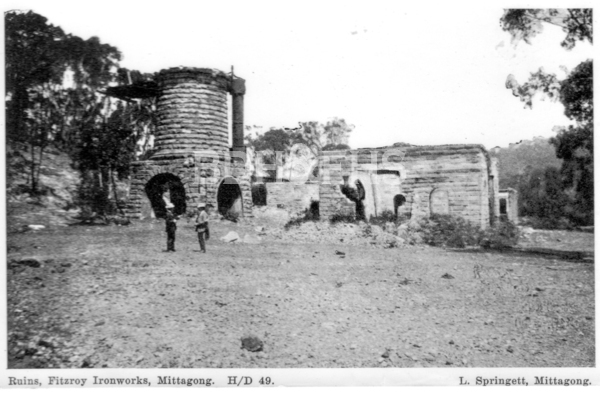
Fitzroy Iron Works blast furnace ruins, about 1900-1910. Source: Berrima District Historical Society [1] - 1871John Frazer
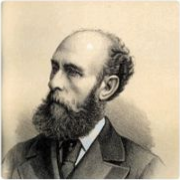
John Frazer (1827 - 1884) Source: NSW Parliament [10] The ironworks had been put up for auction the year before. In January 1870 the Empire reported that the company’s Nattai land, plant, machinery and tools had sold for £10,000. The sale included the works and equipment as well as land, but the report did not name the buyer.[75]
In 1871 the Fitzroy Iron Works Company transferred several holdings to John Frazer of Sydney for £5,000. The previous year, the Empire had reported that Frazer was in England exploring support to reopen the mines. The purchaser appears to have been the same Sydney merchant and investor, bringing the land that would eventually become 7 Lee Street into his wider ironworks interests.
Contemporary accounts point to the Sydney merchant and politician John Frazer (1827-1884). Born in Dromore, County Down, he arrived in Sydney in 1842. After working in the country and then as a clerk, he opened a wholesale grocery business in 1847. In 1853 he married Elizabeth Ewan, and they had two daughters and two sons.[10]
Frazer’s interests grew far beyond the grocery trade. He invested in land and held directorships in banking, insurance and the Australian Gaslight Company. He was among the investors who backed the Fitzroy Iron Works in the 1860s and later helped attract English capital to revive the venture. His association with the works helps explain how the Mittagong land came into his hands.[10][50]
In 1874 he entered the New South Wales Legislative Council, where he served for the rest of his life. He also supported charitable causes and education. His family later contributed funds to the University of Sydney in his memory, and a history scholarship bears his name. Two ornate public drinking fountains were presented to Sydney in his name, one in Hyde Park and another near the Domain.[10][50][51]
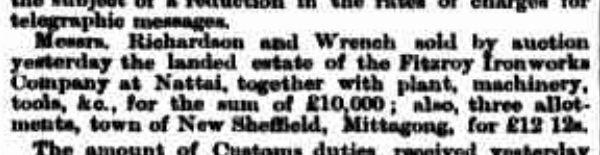
Ironworks auction report, 1870 Source: Empire, via Trove [75] 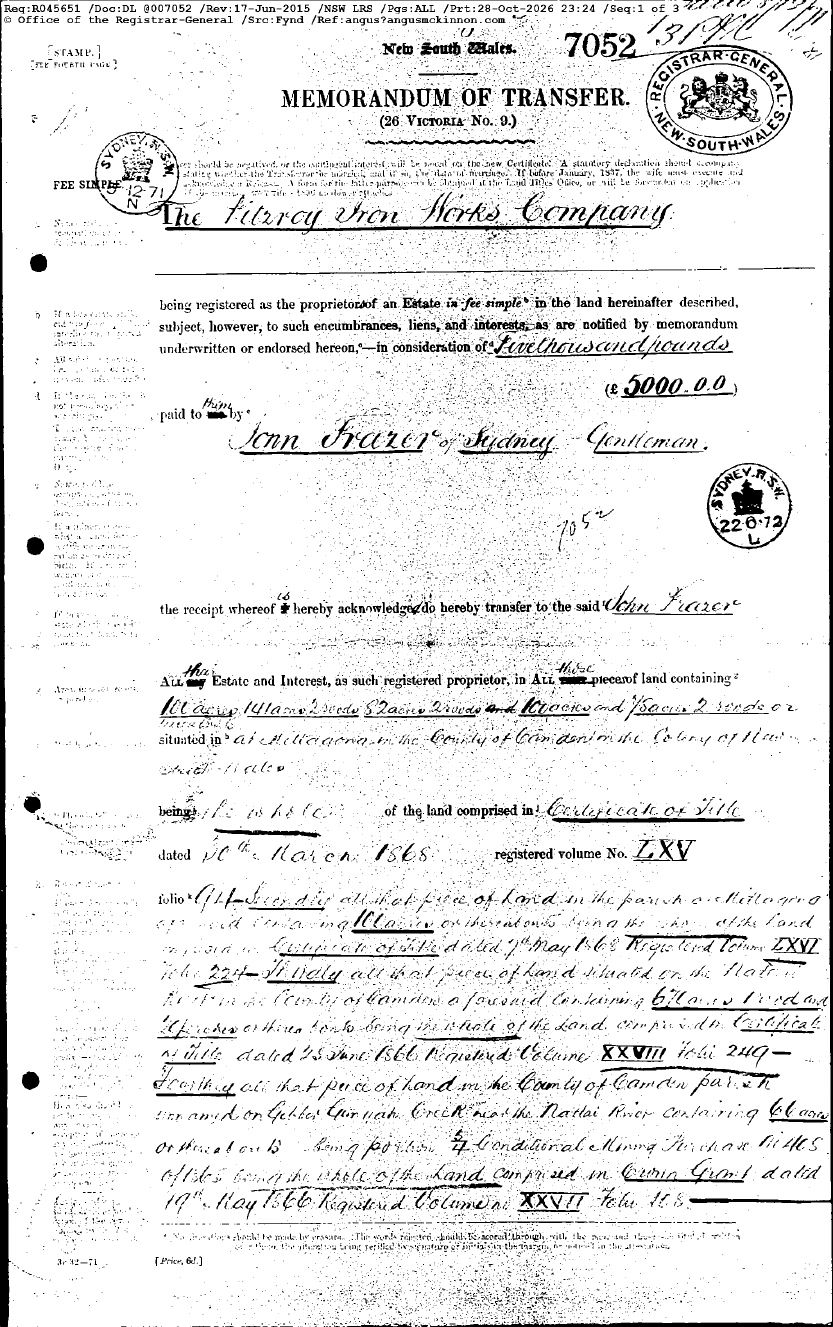
1871 transfer 7052 Source: NSW Land Registry Services, via Fynd [4] 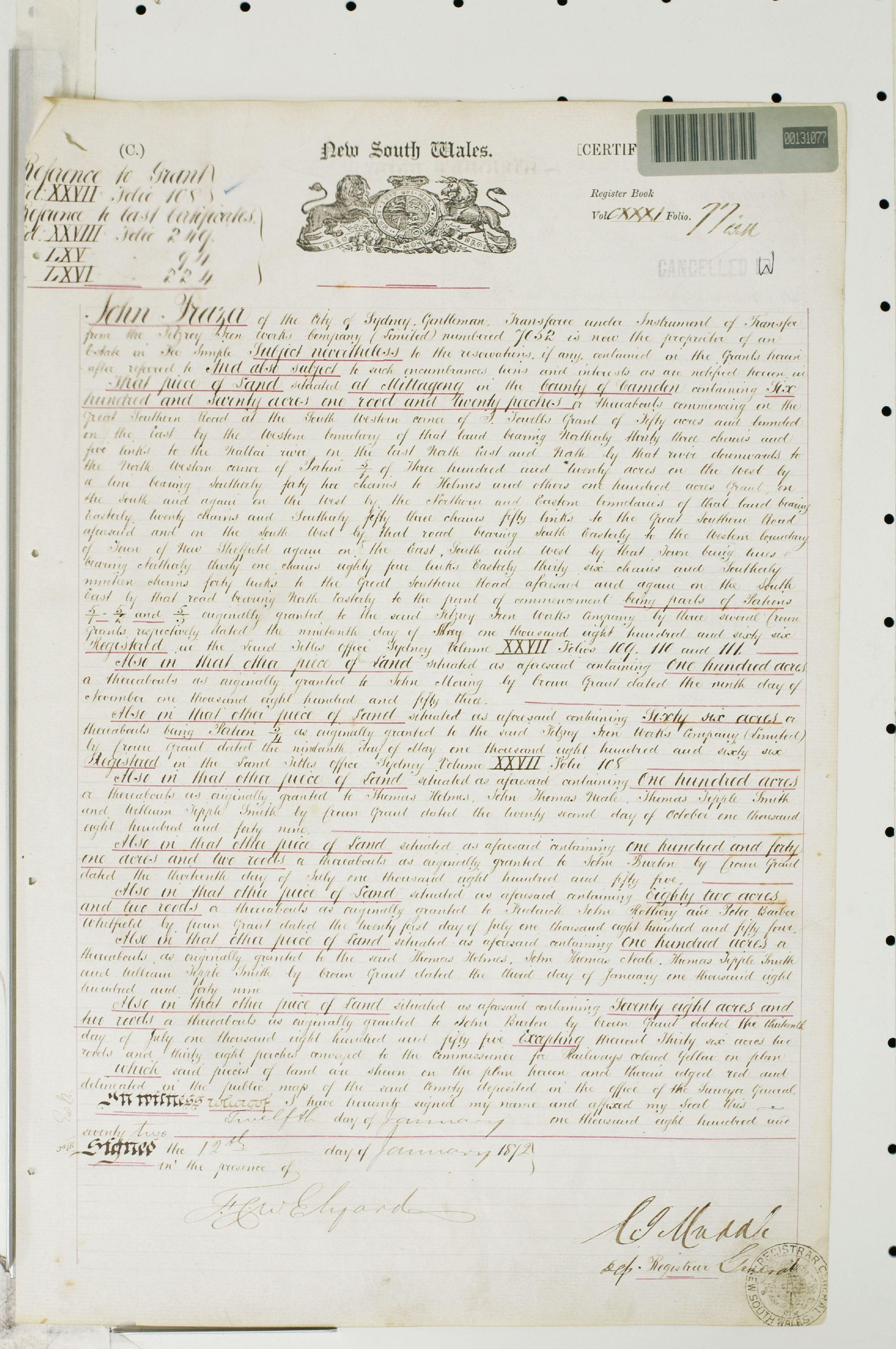
CT131/77 identifying transfer 7052 Source: NSW Land Registry Services [5] 
Historical title Source: NSW Land Registry Services [6] 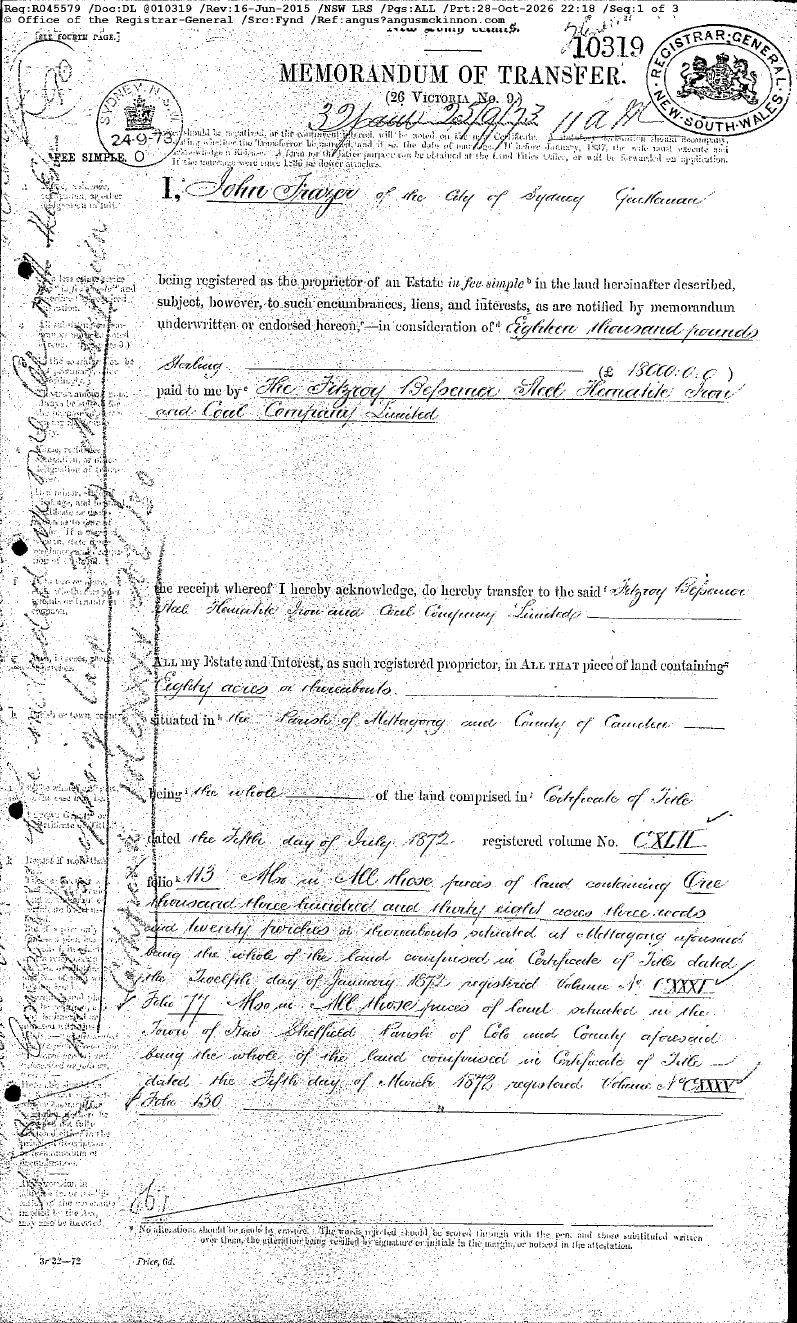
1873 transfer Source: NSW Land Registry Services, via Fynd [7] 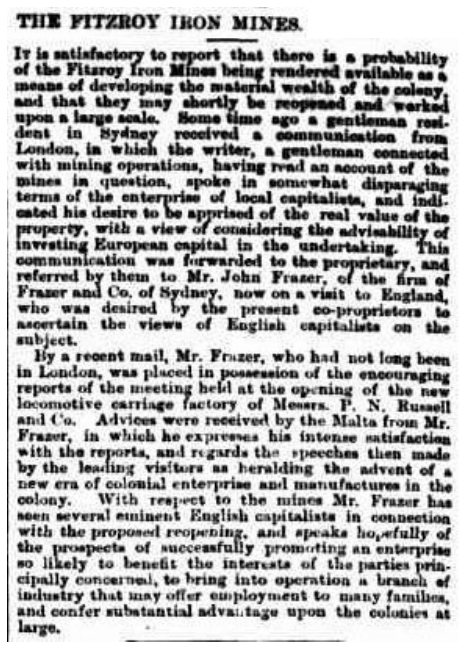
1870 report on the iron mines Source: Trove [8] 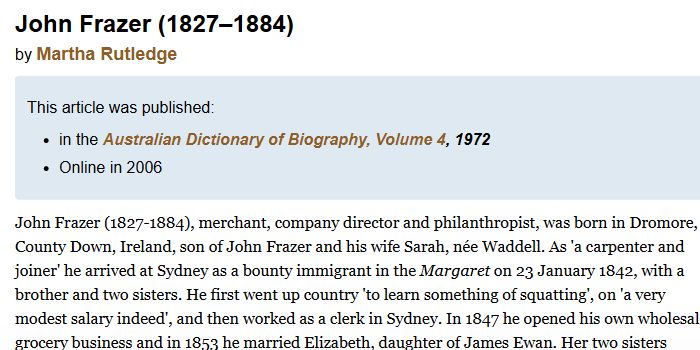
Australian Dictionary of Biography Source: Australian Dictionary of Biography [9] - 1873Fitzroy Bessemer Steel Hematite Iron and Coal Company Limited
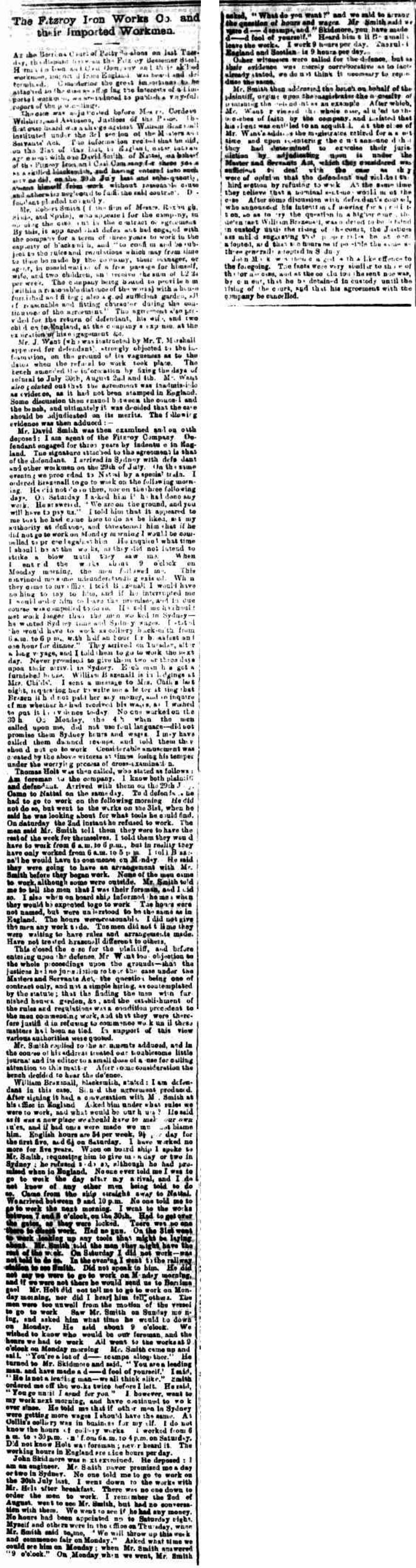
Frazer’s interest in the ironworks led to a new venture. In 1873 a prospectus promoted the Fitzroy estate, ironworks and coal mines as the basis for an ambitious iron and steel company, with hopes of producing railway rails. The company brought skilled workers from England. One was blacksmith William Brazenall, whose reported agreement offered passage for his wife and two children, weekly wages and a furnished house with a garden near the works. A dispute soon arose over when the men were expected to begin and what hours they should work. The company accused Brazenall of absenting himself from work, while he and other workers described a different understanding of their arrangements. The case reached the Berrima court, where the magistrates ordered him detained until the court rose. The following month, Frazer transferred several holdings to the Fitzroy Bessemer Steel Hematite Iron and Coal Company for £18,000.
- 1884Mittagong Land Company Limited
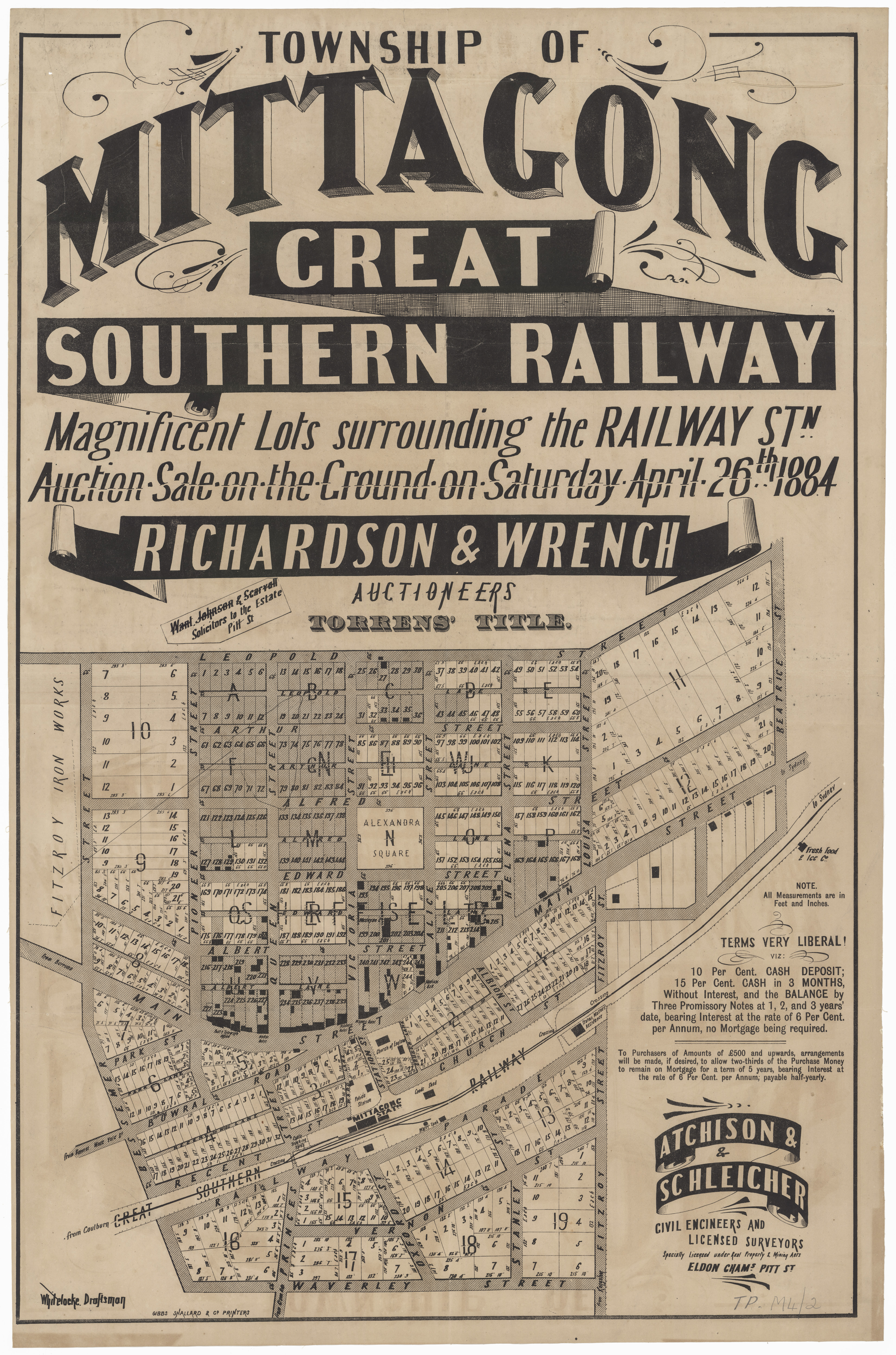
The Fitzroy Bessemer company struggled to operate the ironworks in a competitive market and gave up its lease in 1877. By the early 1880s the company was in liquidation in England. A proposed sale of its Australian land brought the matter before courts on both sides of the world. John Frazer had agreed to sell property to Alexander Speed Webster, and an English court authorised Frazer and Henry Halloran to carry out the conveyances. The New South Wales Registrar-General required a local court order before proceeding, so the matter went to the Supreme Court in Sydney. The orders cleared the way for Frazer to convey the wider estate to the Mittagong Land Company.[45] The agreement recorded £26,000 for a larger collection of land, of which £23,000 was attributed to the land described in the transfer’s schedule. The company began promoting land around Mittagong; an 1891 sale plan shows Section 10, which included the future site of this house, withdrawn from that sale. At an auction near the railway station in April 1884, the new land company’s plans for Mittagong drew a crowd. Historian R. Else Mitchell later wrote that special trains brought visitors from Sydney and about 120 lots were sold. The future house block formed part of the company’s wider estate, although its inclusion in that auction has not been established.[74]
The company also retained an interest in the district’s mineral wealth. In 1892 the local paper reported plans to clear and deepen an old shaft near the ironworks in search of coal. The report hoped the work might help revive the iron mines, a reminder that the company’s estate still carried the legacy of its earlier industrial life.[44]
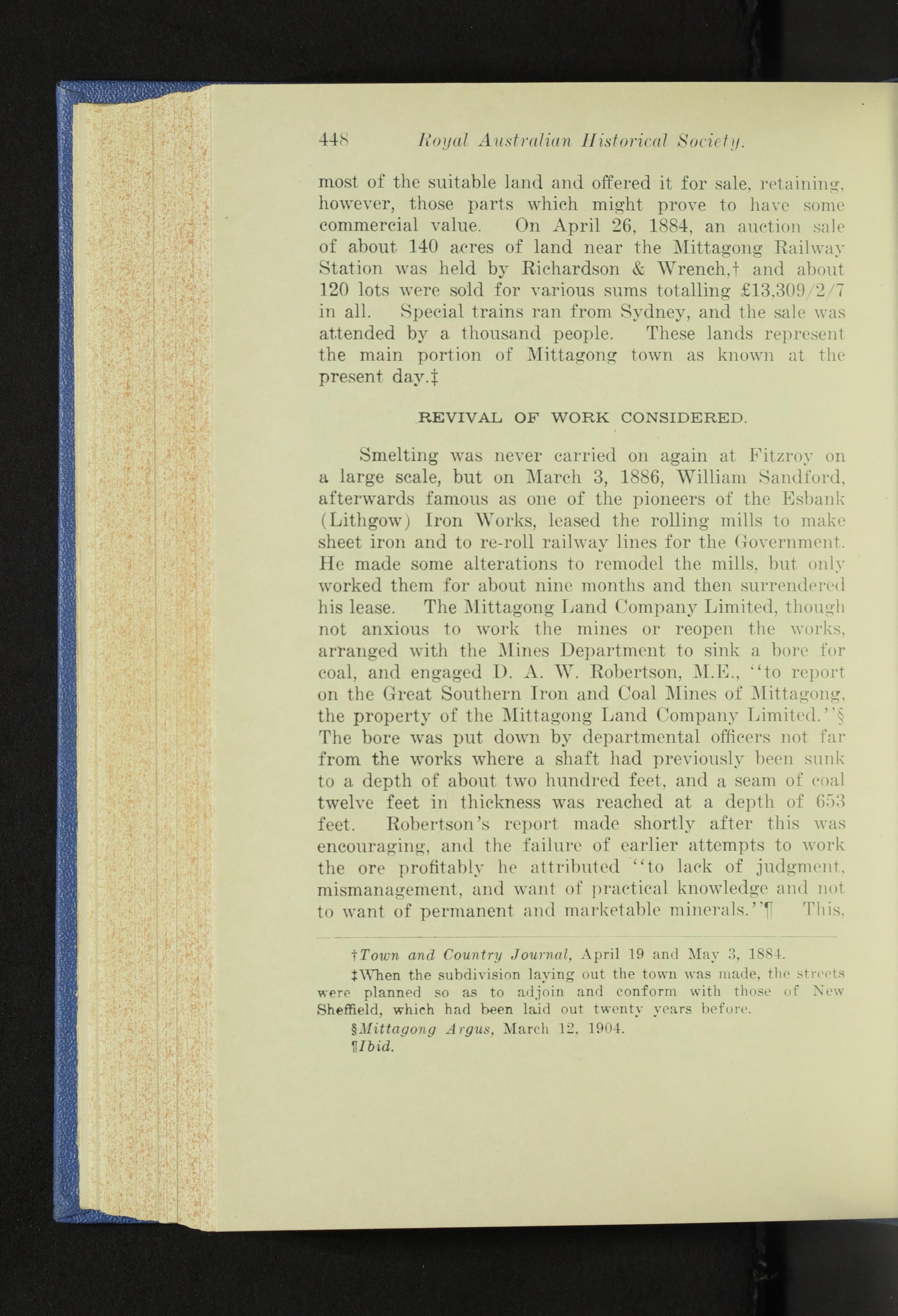
Mittagong land auction, 1884 Source: Royal Australian Historical Society, via Trove [74] 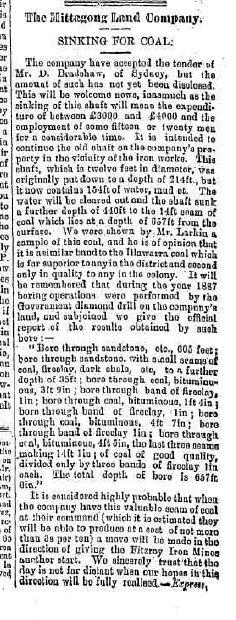
Mittagong Land Company and the coal shaft, 1892 Source: Trove [44] 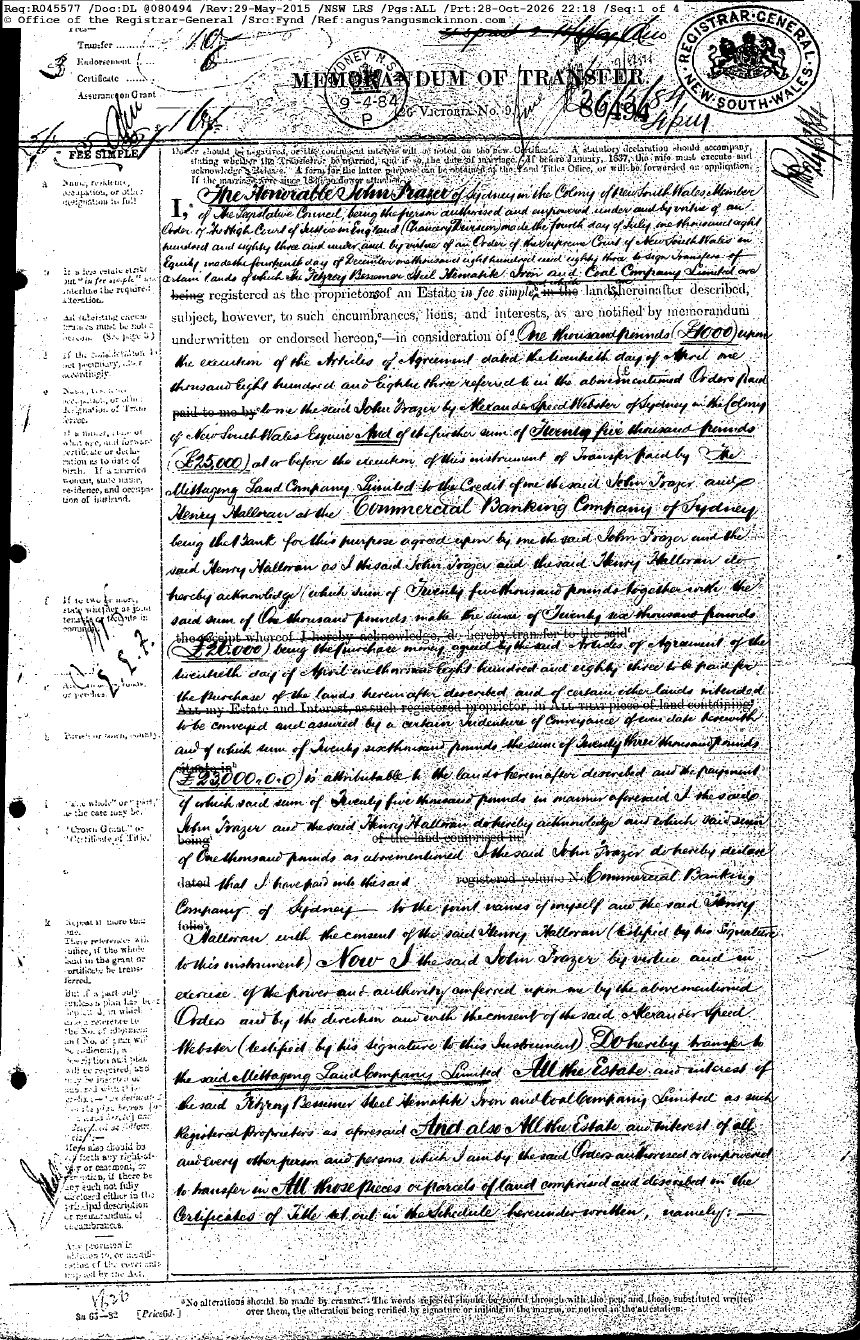
1884 transfer 80494 Source: NSW Land Registry Services, via Fynd [12] 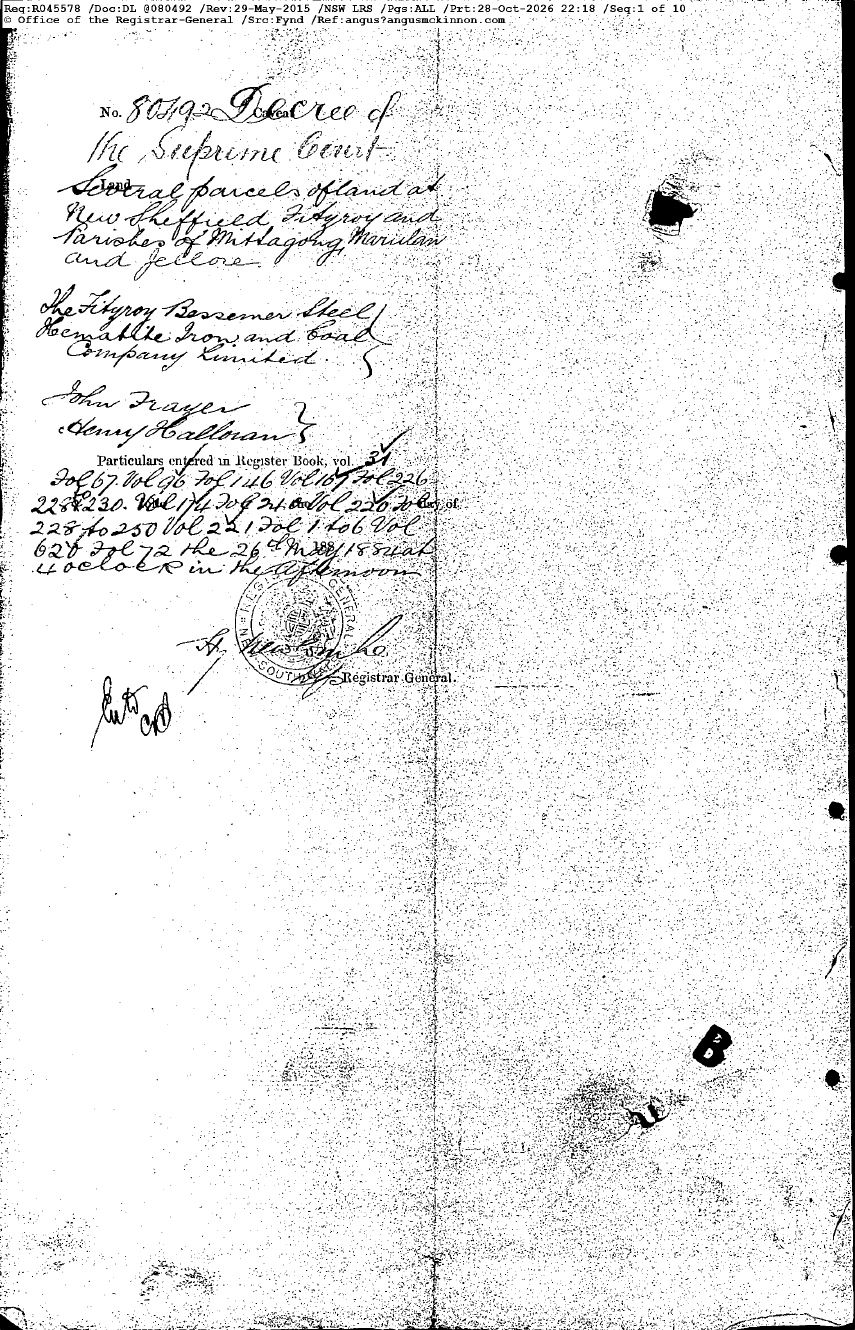
1883 court decree 80492. Source: NSW Land Registry Services, via Fynd [13] 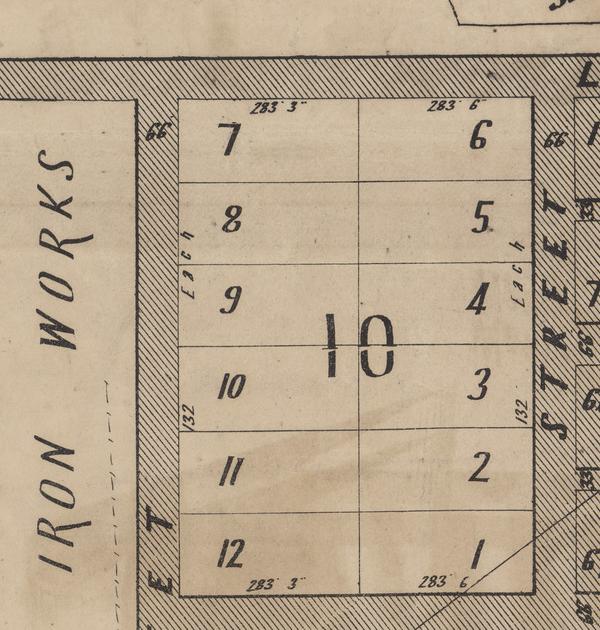
1884 sale plan: Section 10 of the wider estate. Source: State Library of NSW [14] 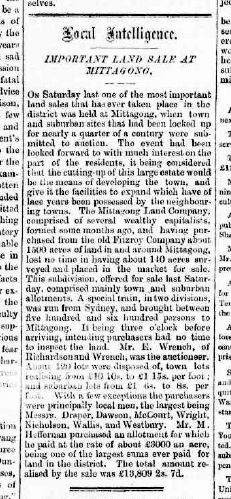
Bowral Free Press reported the 1884 estate auction; the report does not identify a sale of this lot. Source: Trove [15] 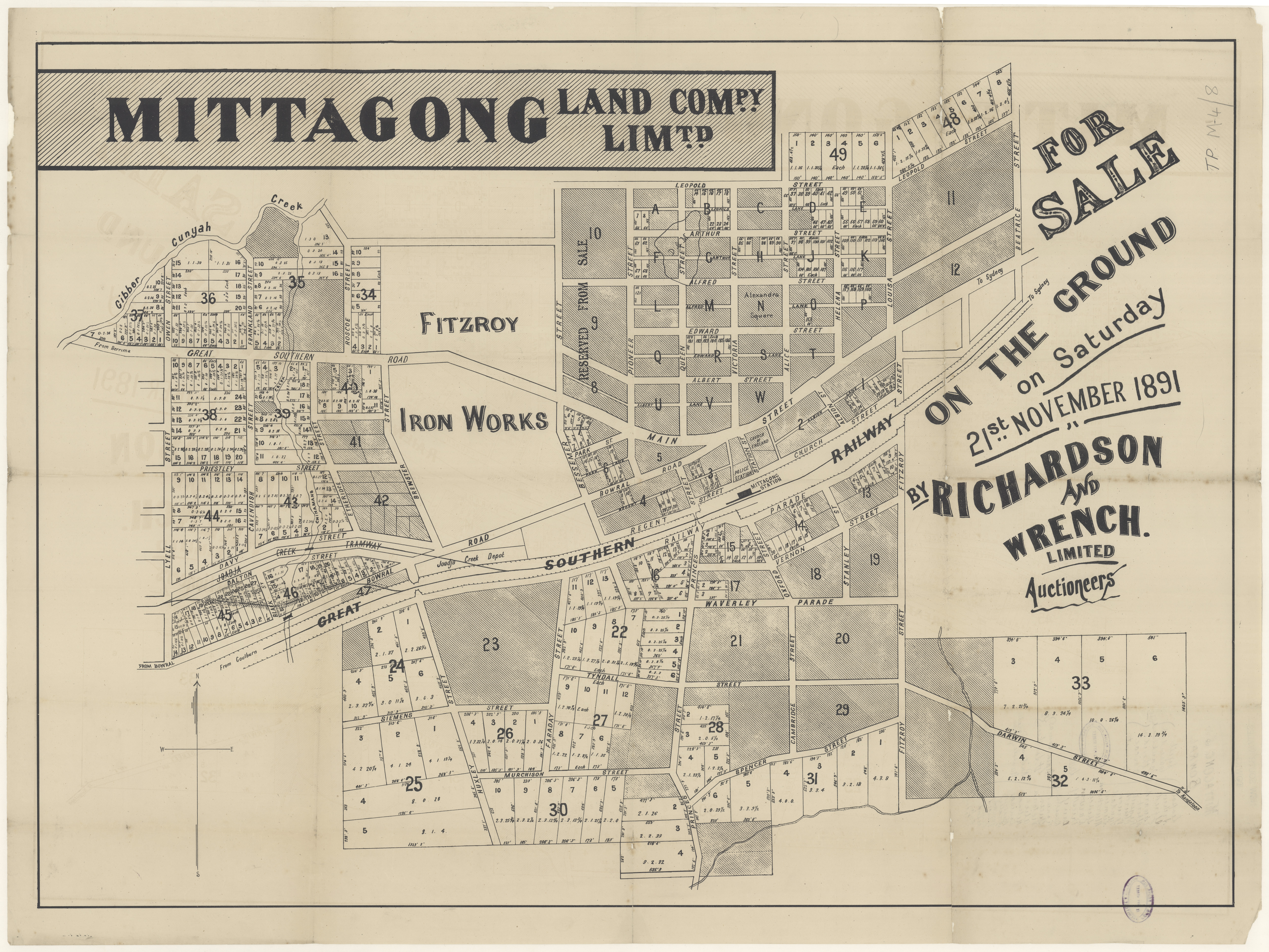
1891 sale plan marks Section 10 withdrawn from sale. Source: State Library of NSW [16] - 1918Claude Newton Lee
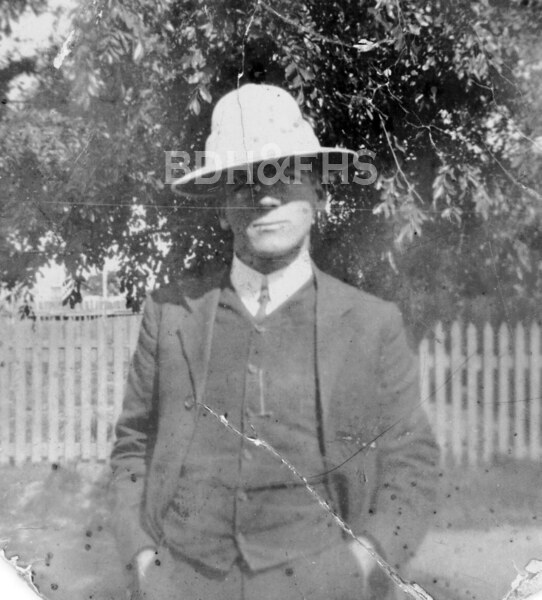
Claude Newton Lee, about 1930. Source: Berrima District Historical Society [26] In 1918 Claude Newton Lee, Mittagong’s shire clerk, bought twelve lots in Section 10 for £111. The deed describes just over ten acres in all, including the land that would become 7 Lee Street. Even as the district looked towards a residential future, the land company retained rights to mine and remove minerals, with conditions concerning enjoyment of the surface, a reminder of the estate’s industrial past. Lee went on to create Sunset Point Estate. For a November 1926 auction, agents promoted more than 60 residential blocks, their views, building covenants, and the availability of water and electric light. They even encouraged buyers to make a picnic of the sale, and offered lithographed plans through the auctioneers Burton of Bowral and W. H. Jones of Mittagong. Another advertisement promised quiet streets and mountain views, and said Burton of Bowral was displaying photographs of the panorama from Sunset Point Road. It even joked that a husband could keep his wife's affection by letting her choose a Sunset Point block. In 1927 a Sydney newspaper advertised 60 Sunset Point home sites, describing lake frontage and mountain views and offering interest-free terms. Enquiries were directed to Lee. That year the local paper also reported his agreement with council over the estate’s water mains. In 1928 Lee also put forward a plan to change roads near Lake Alexandra, including a new street between Queen and Alfred Streets. The council agreed to meet him on the ground to discuss it. Twenty years later, Lee told the council that Sunset Point was growing quickly and needed a larger water main along Pioneer Street. He mentioned a nearby property occupied by W. Isedale. He also wanted to improve nearby Lake Alexandra. In 1948 he suggested deepening the water and creating a scenic drive, and told the council he had given land at the corner of Alfred Street to provide access to the lake.[63]
Claude and Gladys made their home at Leslie Cottage in Queen Street. His life reached well beyond the land office. In 1913 he married Gladys Stokes at Bowral Methodist Church. The local paper described a crowded church decorated with ivy, flowers and white ribbons. A large wedding bell hung above the couple and showered them with confetti at the end of the ceremony. A choir sang, around 100 guests attended the reception, and the couple left for a honeymoon on Norfolk Island. A later Berrima District Historical & Family History Society account describes Claude as a bandsman, bushwalker, local sporting organiser and manager of Bowral’s Empire Theatre. He also wrote about the Burragorang Valley. The Society’s account and another family-history source disagree over his birth year, so it remains to be confirmed.
His public role is visible in the records: a 1926 Commonwealth Gazette names him as Mittagong’s assistant returning officer and shire clerk. Whether Lee Street was named for him or his family is still an open question.
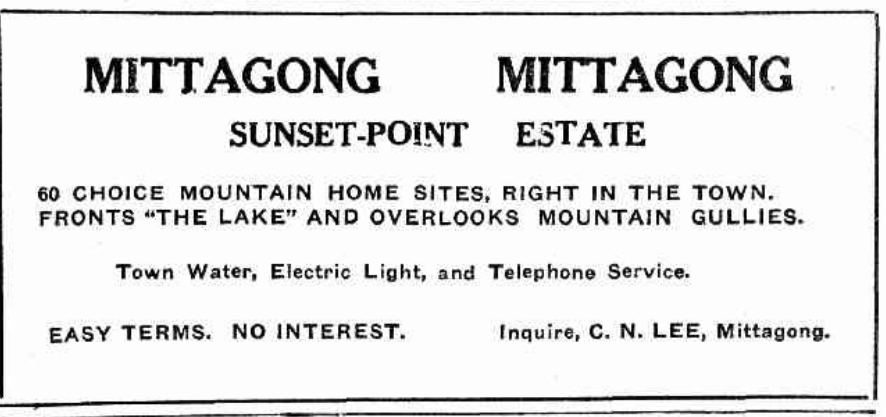
Sunset Point Estate advertisement, 1927Source: Trove [57] 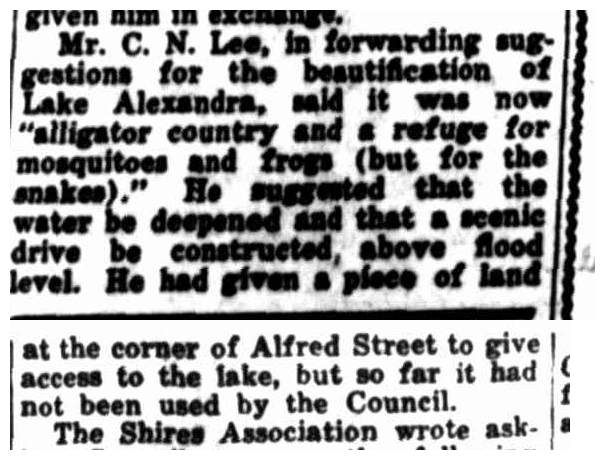
Claude Lee’s ideas for Lake Alexandra, 1948 Source: Trove [63] 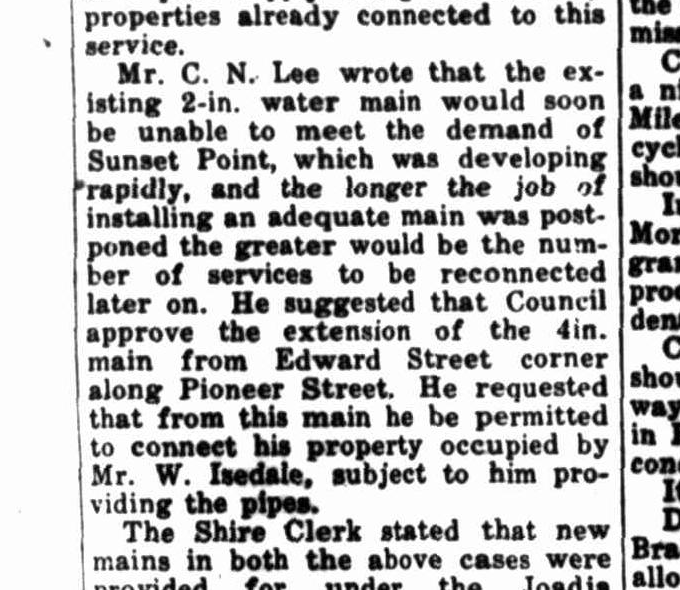
Claude Lee and the Sunset Point water supply, 1948Source: Trove [63] 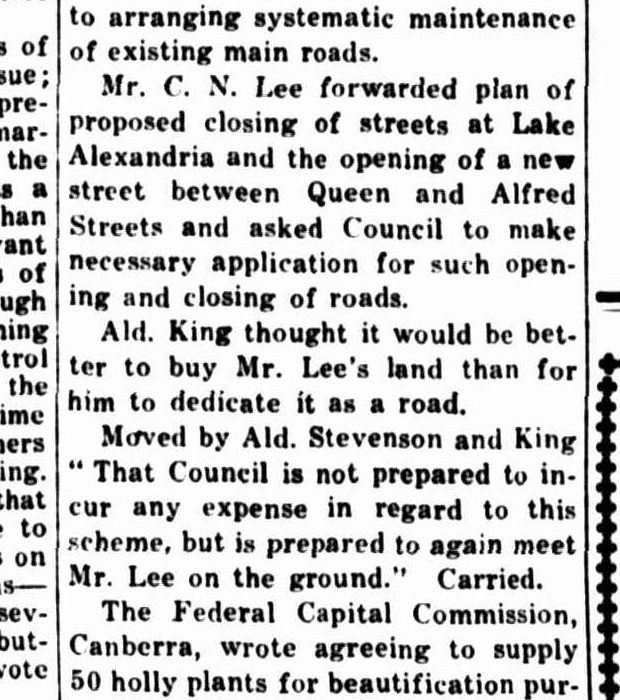
Claude Lee’s proposed road changes, 1928Source: Trove [56] 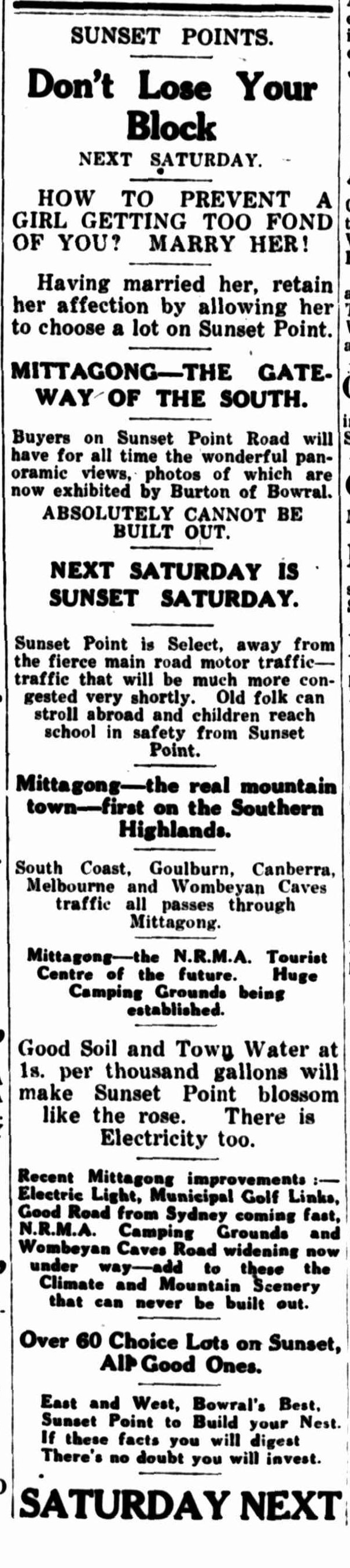
Sunset Points advertisement, Robertson Mail, 26 November 1926 Source: Trove [17] 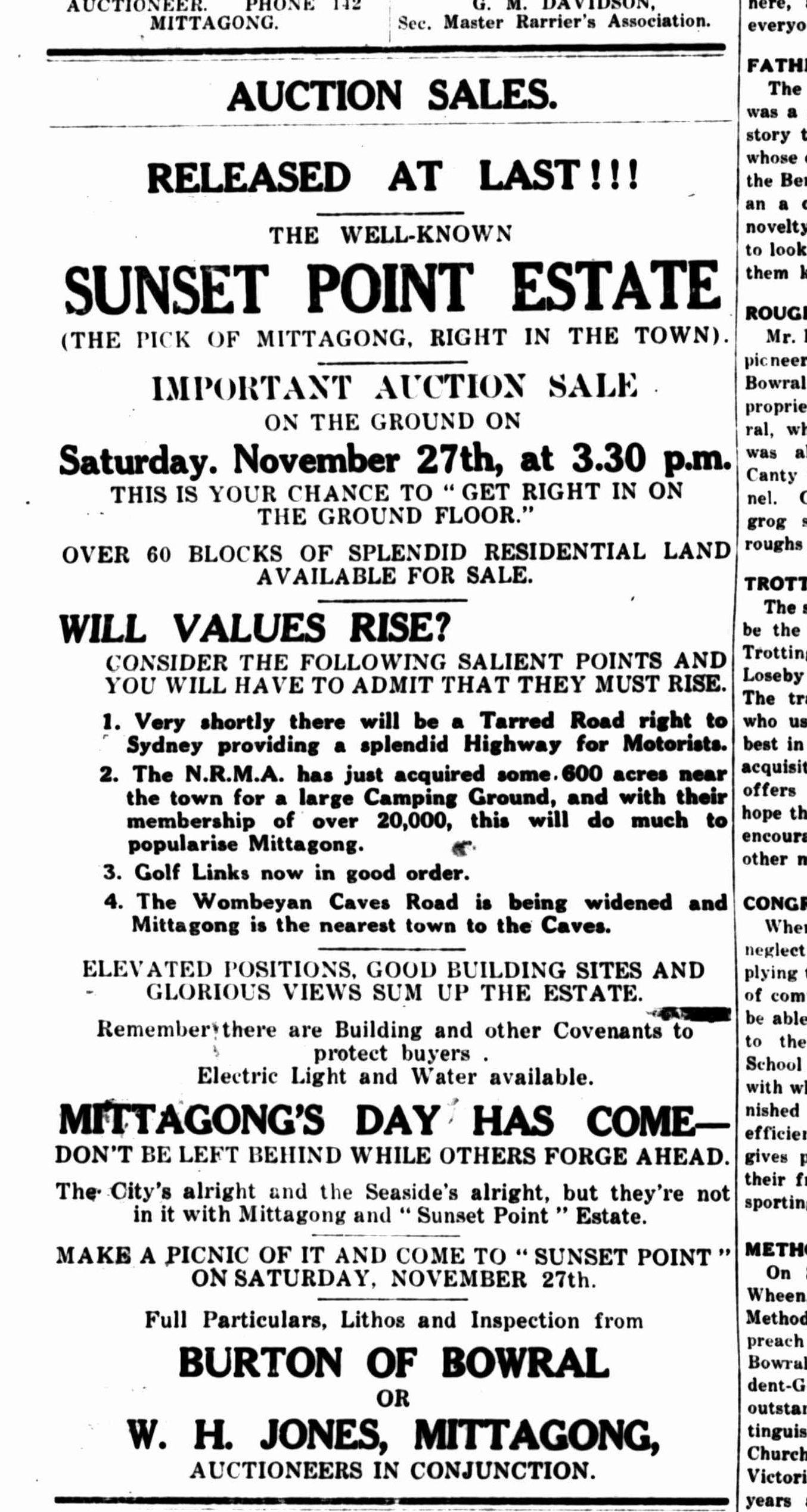
Detailed 1926 auction advertisement, Robertson Mail Source: Trove [18] 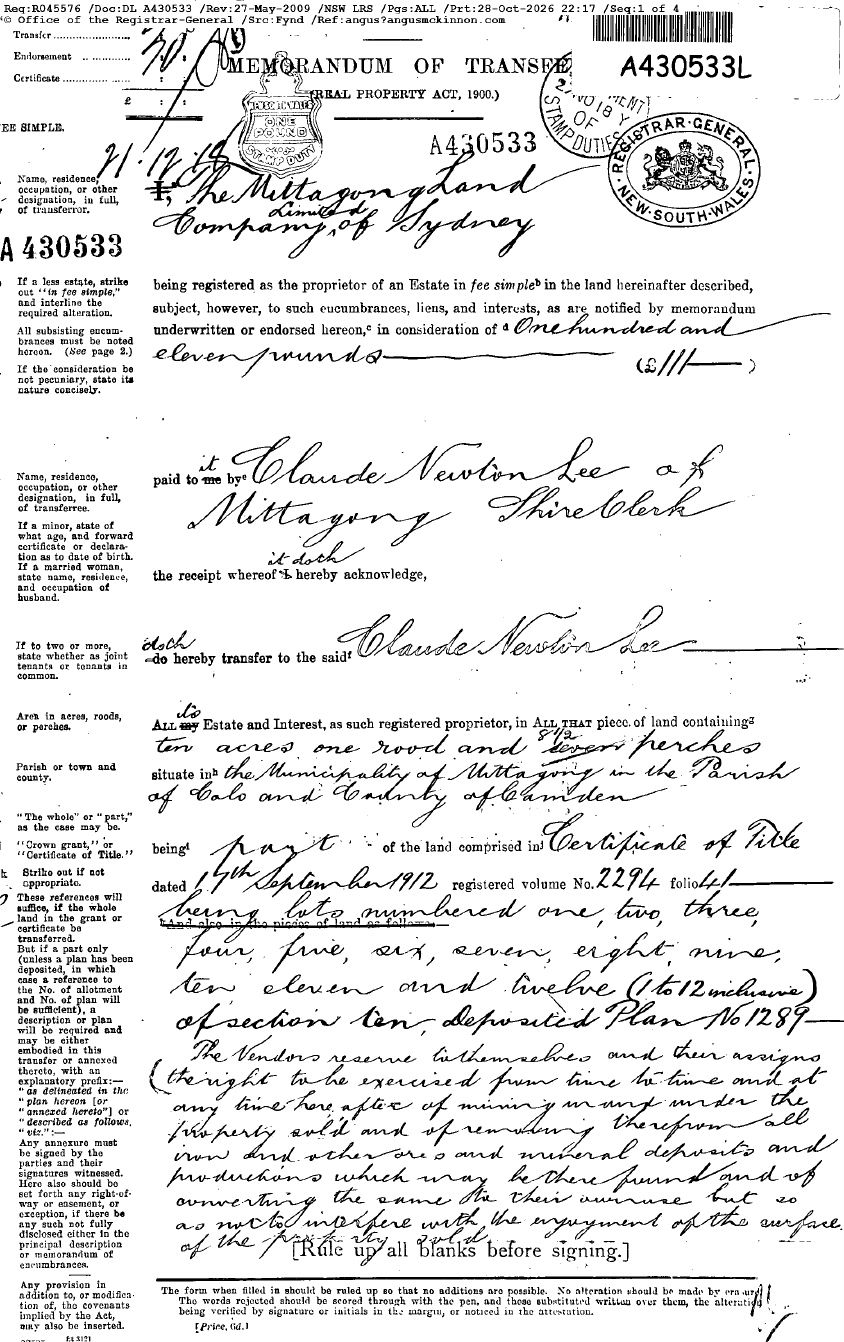
1918 transfer A430533 Source: NSW Land Registry Services, via Fynd [19] 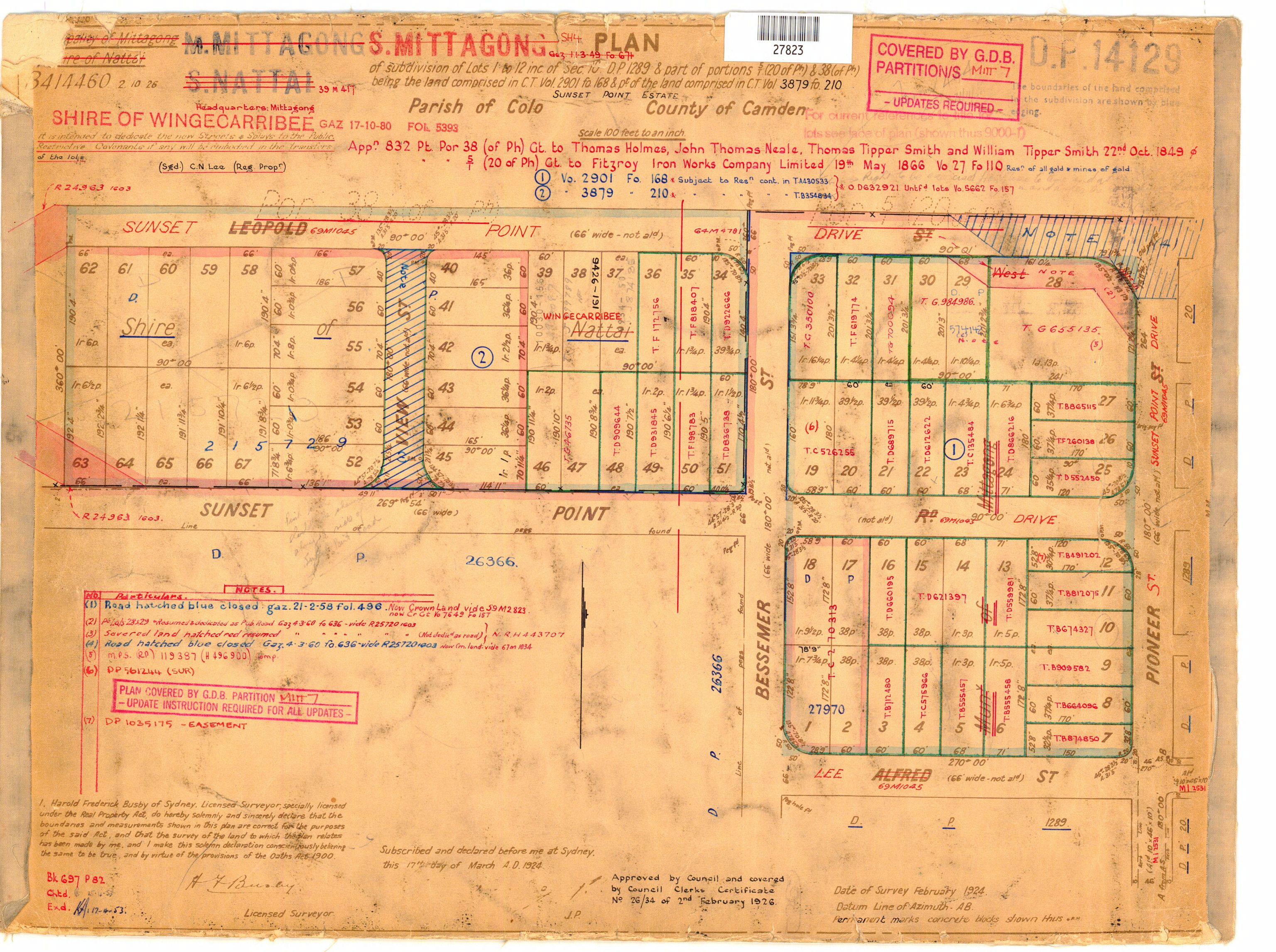
Sunset Point Estate subdivision plan, surveyed in 1924. Source: NSW Land Registry Services [20] 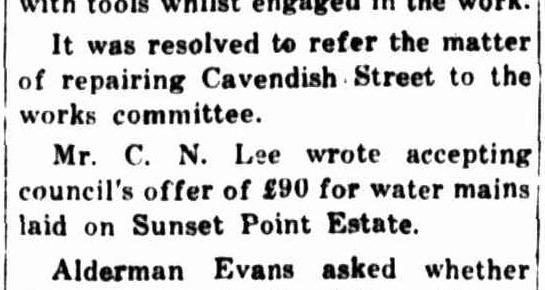
In 1927 the Southern Mail reported Lee’s agreement over estate water mains. Source: Trove [21] 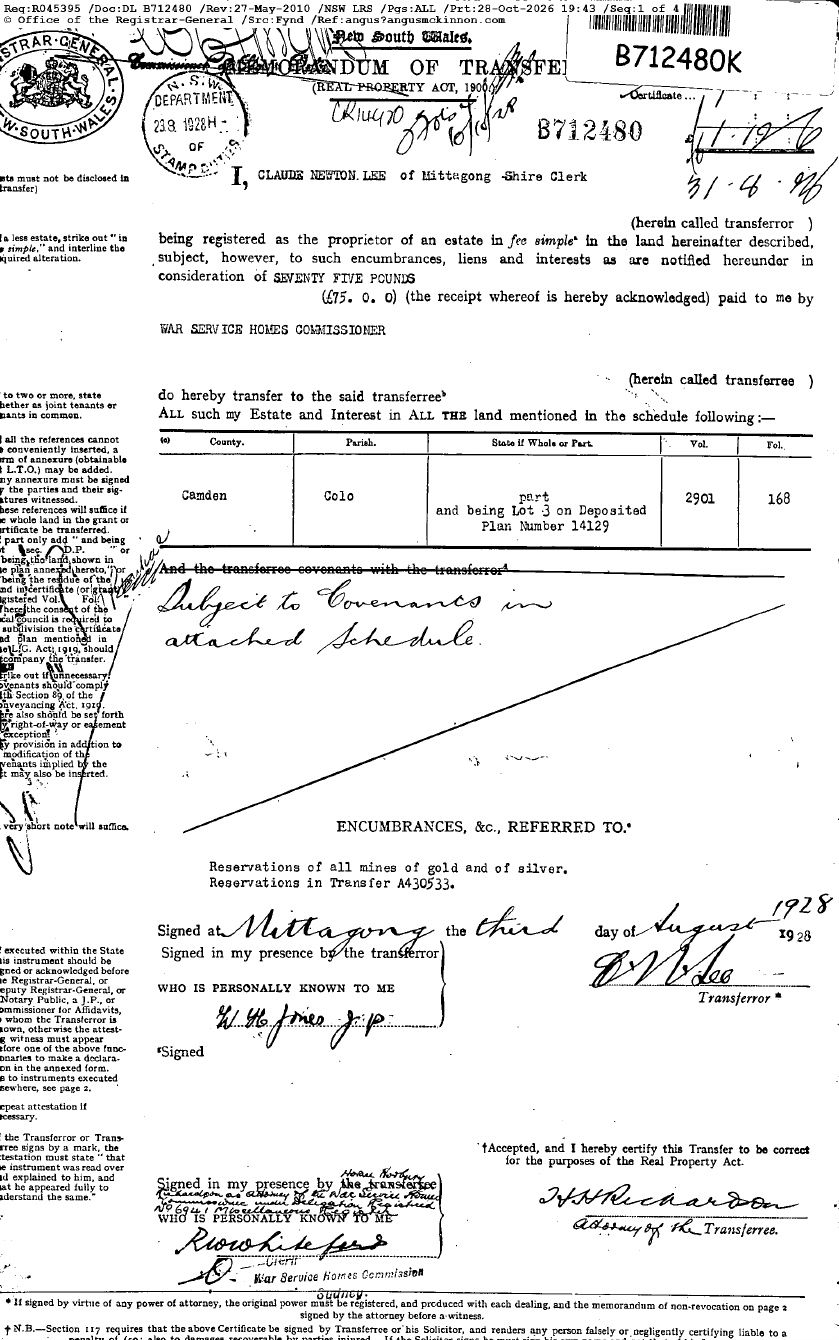
1928 transfer Source: NSW Land Registry Services, via Fynd [22] 
1913 wedding report · complete article Source: Trove [23] 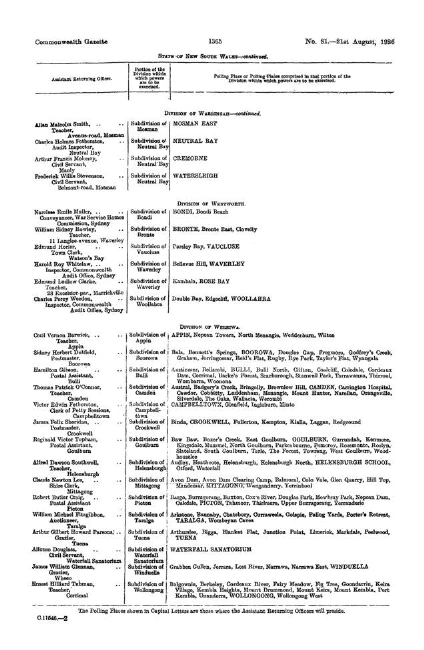
1926 Gazette, page 1365 Source: Commonwealth Gazette [24] 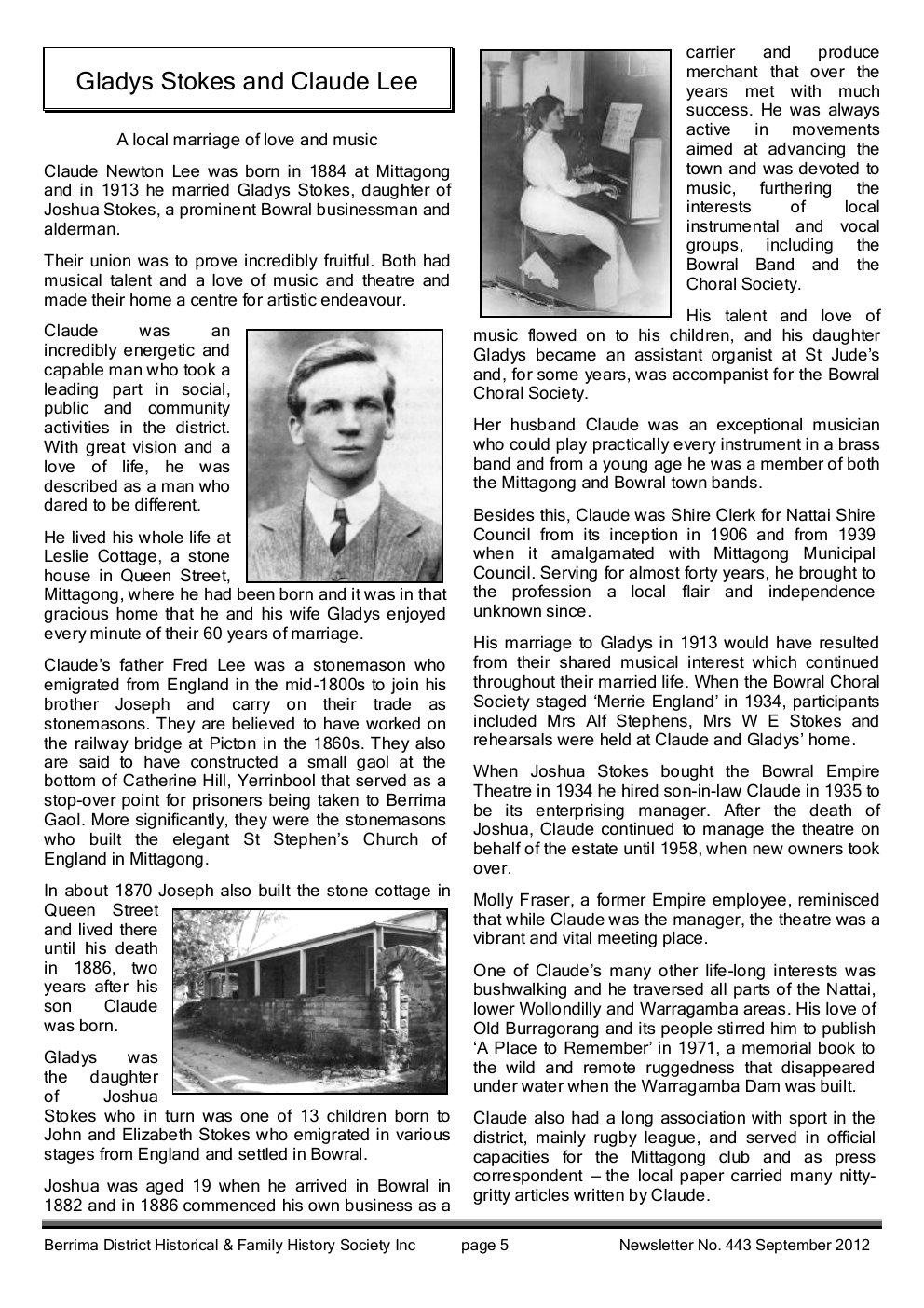
Society biography, pages 5-6 Source: Berrima District Historical Society [25] 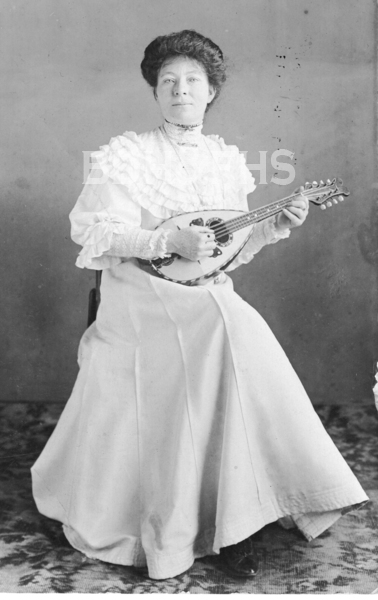
Sarah Gladys Lee, about 1915. Source: Berrima District Historical Society [27] 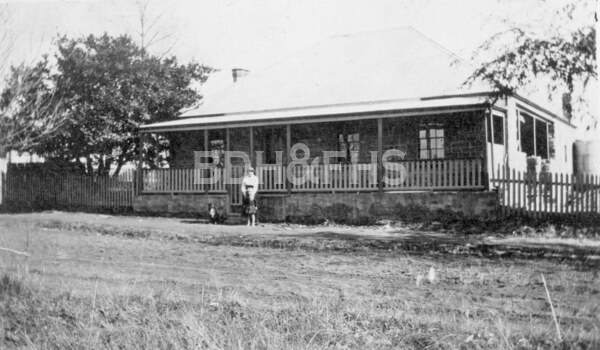
Leslie Cottage, about 1935: Claude and Gladys Lee’s home in Queen Street, not 7 Lee Street. Source: Berrima District Historical Society [28] - 1928War Service Homes Commissioner
In 1928 Lee sold Lot 3 to the War Service Homes Commissioner for £75. Lee attached conditions to the sale to shape the neighbourhood he was developing. Any main house built on the block had to be worth at least £500 and stand at least 24 feet back from the street. Only one main building was allowed, and the block could not be used for a factory or a noxious trade. Lee also ruled out advertising hoardings and limited poultry to 20 birds. He would not be required to contribute to dividing fences, and stone or gravel could be removed only for building on the block.
The War Service Homes scheme helped eligible returned servicemen and their families find homes after the First World War. Its original legislation allowed the Commissioner to acquire land and houses, arrange construction and offer financial assistance. One pathway was rent-purchase, under which an occupying purchaser made payments towards owning a home.[53] In 1929 the Commission listed a minimum £10 deposit and 5 per cent annual interest for eligible applicants, with loan terms varying according to whether the home was timber or brick.[55]
Across New South Wales, the scheme combined building with buying houses. By June 1929 the Commission reported 5,788 homes completed and 4,196 purchased since the scheme began. In the year that included its purchase from Claude Lee, it recorded 449 homes completed and 61 purchased across the state.[55] The report also described homes that had returned to the Commission: in New South Wales, 11 of the 31 such homes held in June 1929 were occupied by tenants.[55]
By 1920 the local Nattai district returned servicemen’s branch was already inviting sailors and soldiers to enquire about the War Service Homes scheme. By the time the Commissioner bought this block from Claude Lee in 1928, the scheme was already part of local life.
During the 1930s, local council reports recorded changes along Alfred Street. In 1933 Mr C. Riley asked for attention to the road between Louisa and Beatrice Streets, and in 1934 the council approved a weatherboard cottage somewhere on Alfred Street.[64][65] For much of the Commissioner’s time as owner, this stretch of road was called Alfred Street. In 1972 Mittagong Shire Council renamed the section west of Pioneer Street Lee Street, giving the address the street name it carries today. The Gazette notice also records the creation of Sunset Point Drive from several earlier streets.
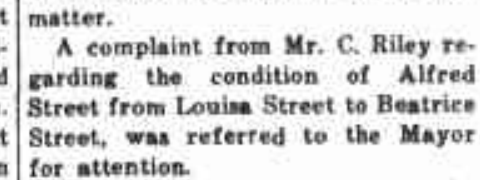
Alfred Street road conditions, 1933Source: The Southern Mail [64] 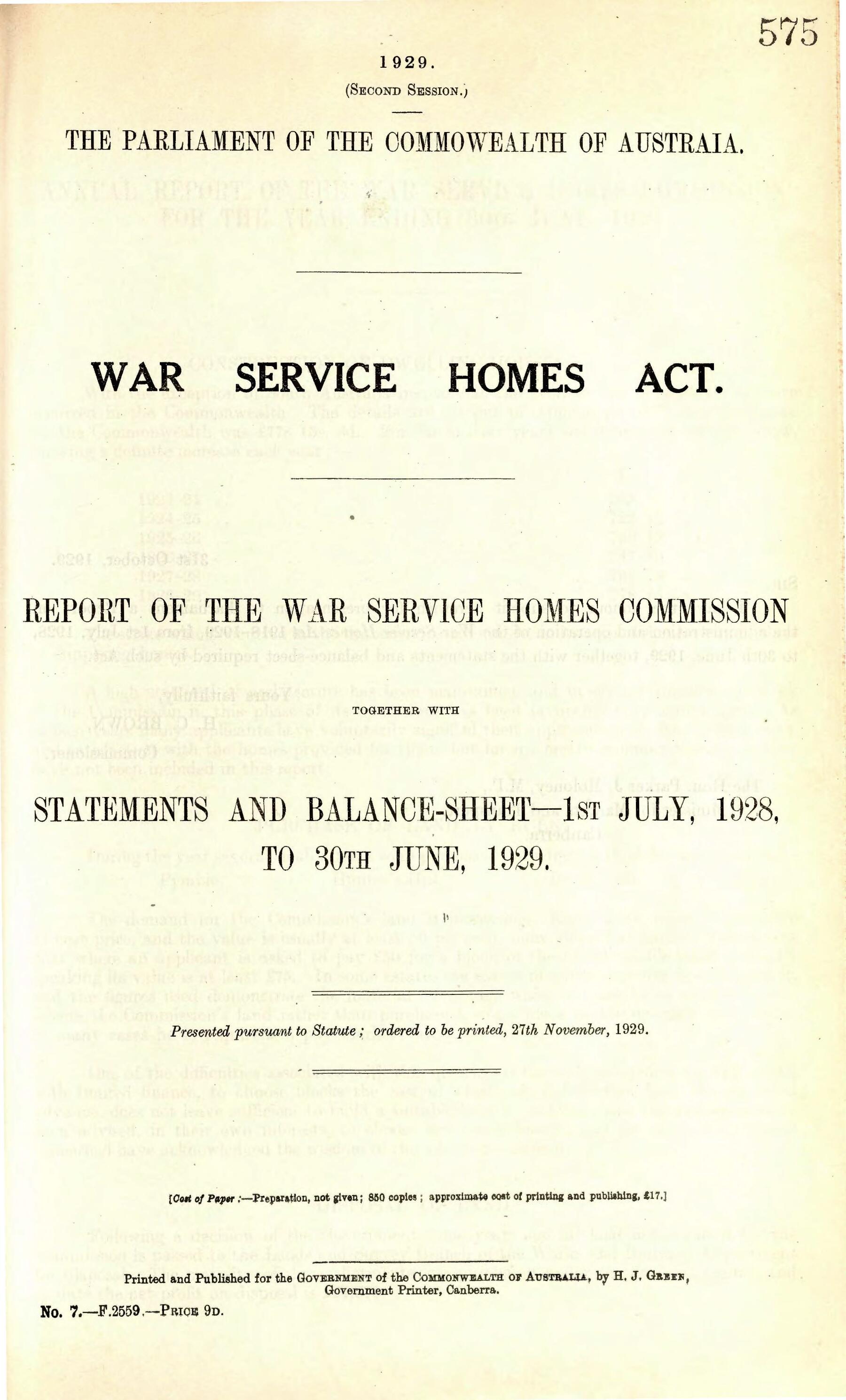
War Service Homes Commission annual report, 1929 Source: National Library of Australia [55] 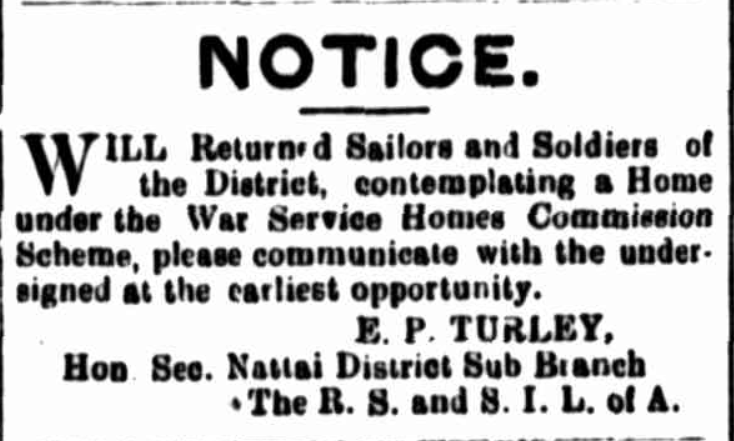
Local War Service Homes notice, Robertson Advocate, 27 February 1920 Source: Trove [29] Full 1928 transfer Source: NSW Land Registry Services, via Fynd [22] 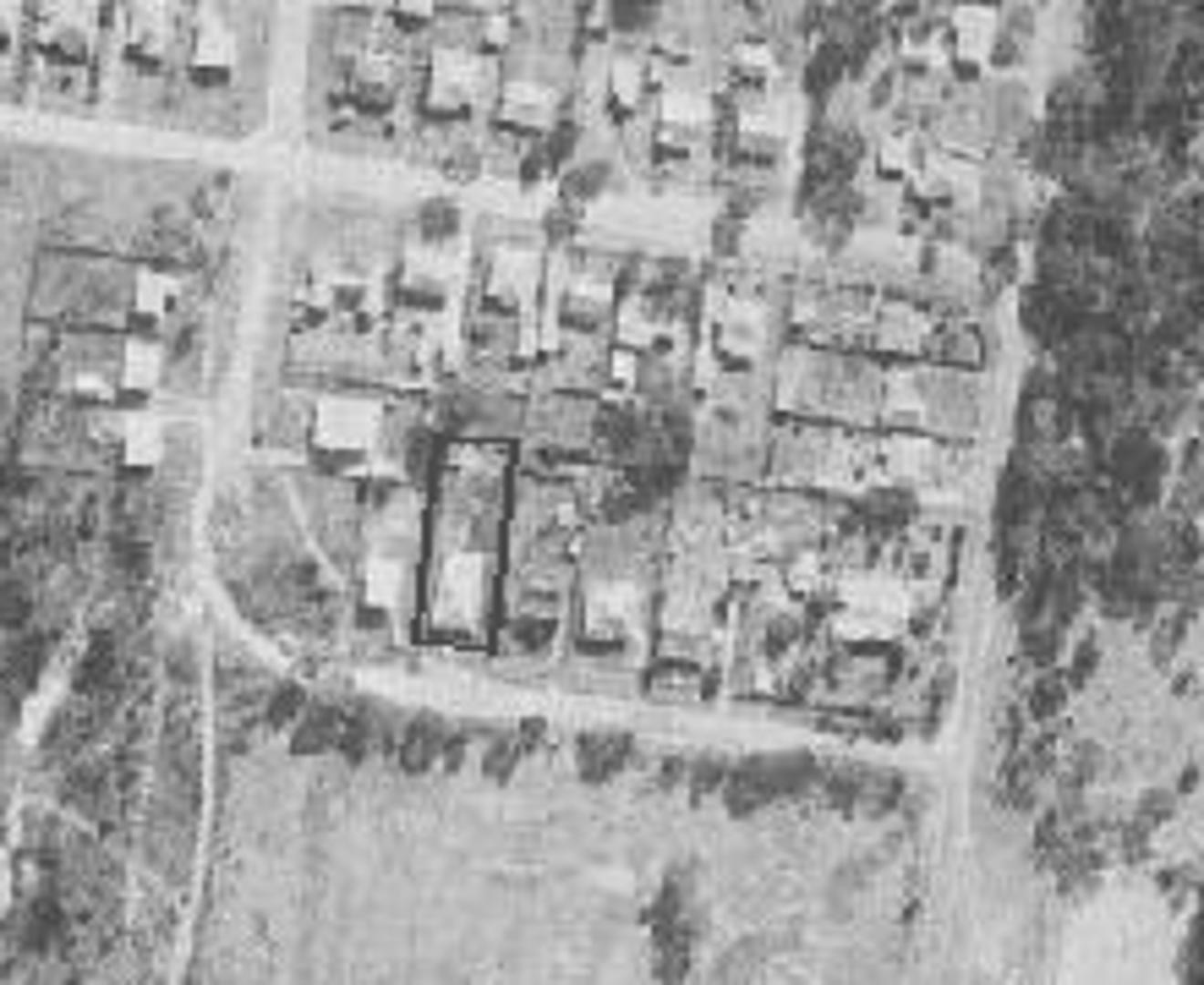
1963 aerial: the approximate lot location appears to contain a building; placement and building identity remain provisional. Source: NSW Historical Imagery [30] 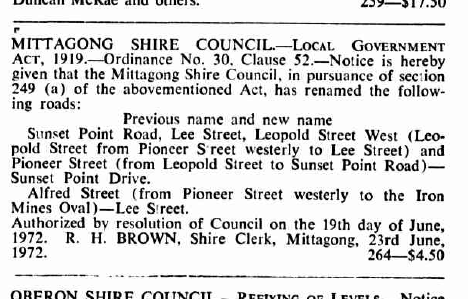
1972 Gazette notice of the street renamingSource: Trove [38] - By 1977Defence Service Homes Corporation
Almost fifty years after Claude Lee sold the block to the War Service Homes Commissioner, the government housing scheme had a new name. By 1977 the Defence Service Homes Corporation held the title. Over the years, the organisation changed along with the scheme: the Commissioner became the Director of War Service Homes in 1947, then the Director of Defence Service Homes in 1973. In 1975 its property passed to the Australian Housing Corporation, which became the Defence Service Homes Corporation in 1976.[59][60][61][62]
On 6 May 1977 the Corporation signed the transfer to Thomas and Eunice Byron. It was registered on 30 May, bringing the long period of government ownership to an end.[31]
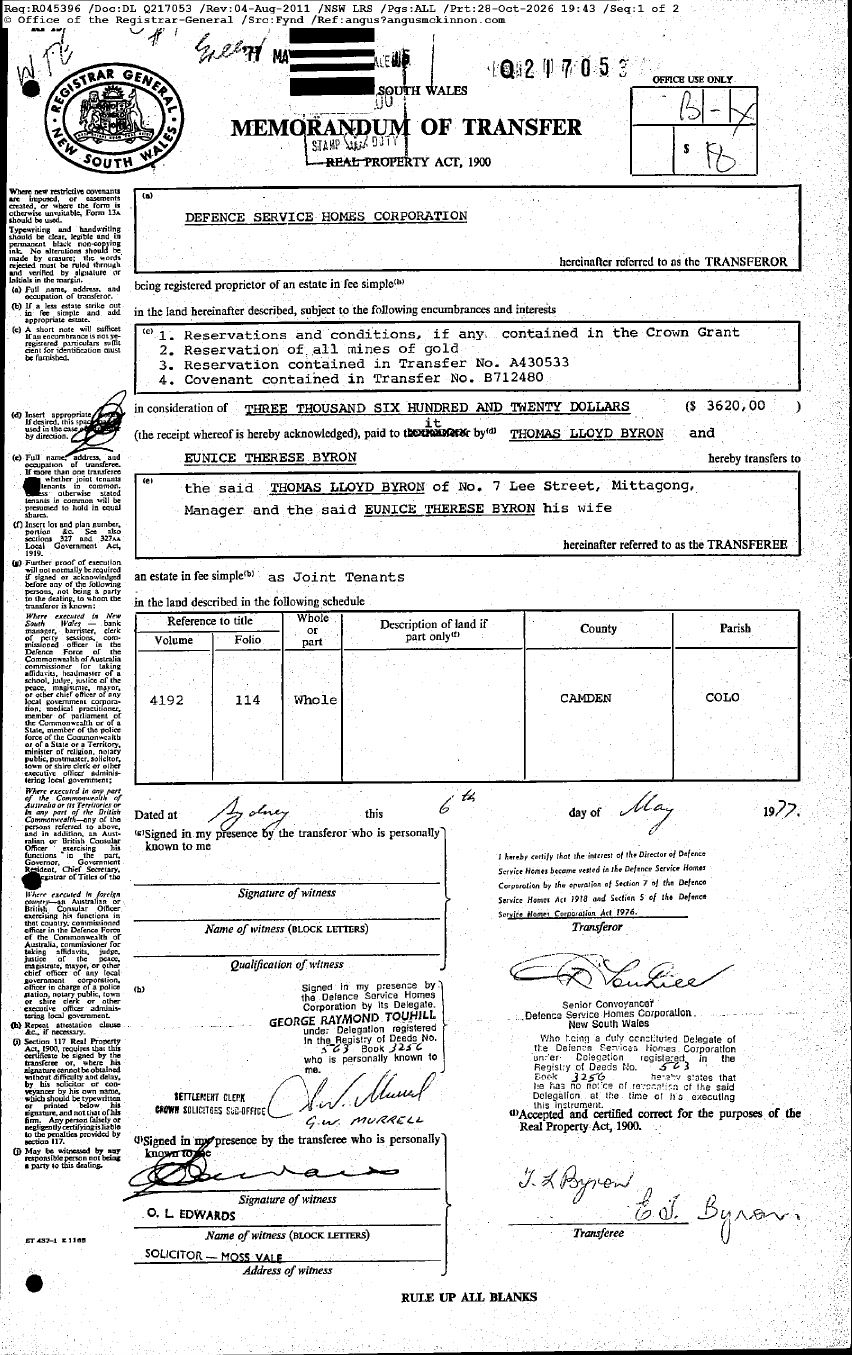
Full 1977 transfer Source: NSW Land Registry Services, via Fynd [31] - 1977Thomas Lloyd Byron & Eunice Therese Byron
In May 1977 Thomas Lloyd Byron and his wife Eunice bought 7 Lee Street together for $3,620. Thomas was described in the deed as a manager already living at the address, giving us the first confirmed name of a person who called the house home.
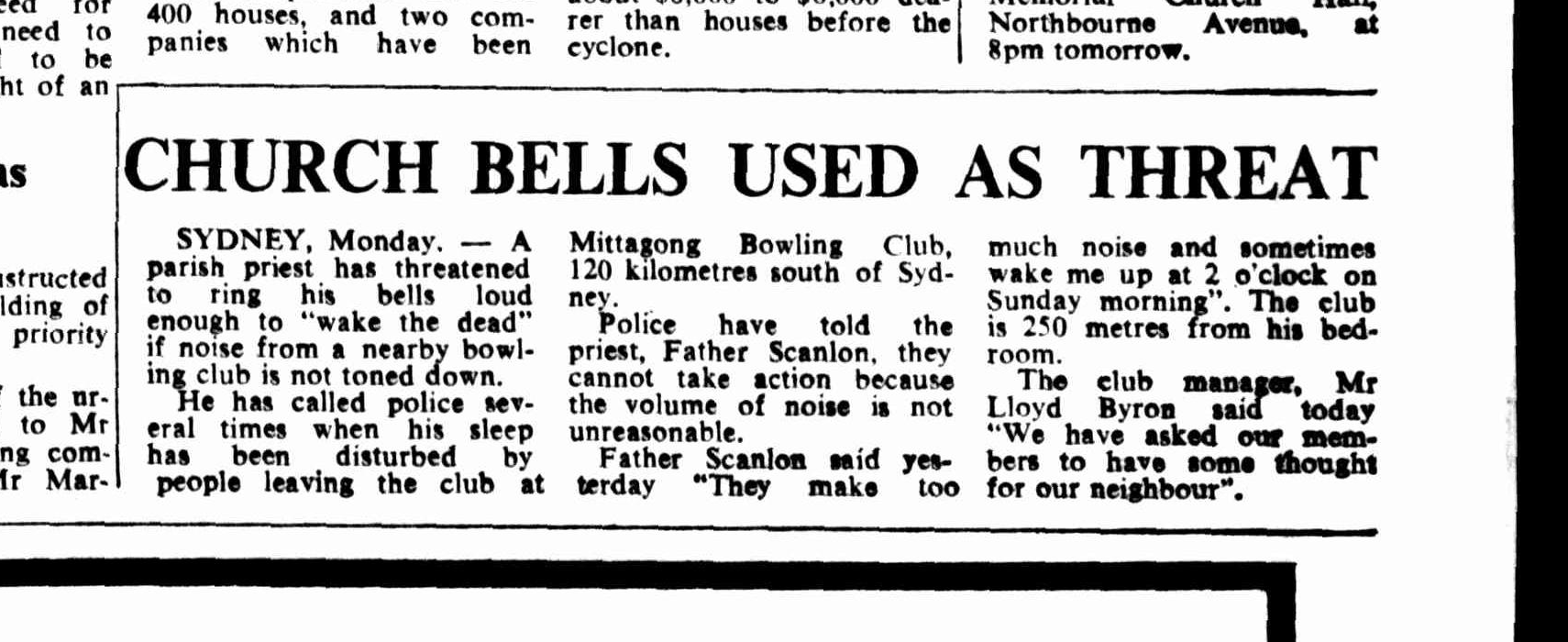
Thomas was known as Lloyd.[39] In 1975, the Canberra Times reported that Father Scanlon, a local parish priest, was being woken by people leaving Mittagong Bowling Club late at night. He threatened to ring the church bells if the noise continued. The club’s manager, Lloyd Byron, said members had been asked to show consideration for their neighbour. The manager’s name, location and occupation suggest a connection with Thomas, who was described as a manager in the 1977 transfer.[34]
- 1990Eunice Therese Byron
Thomas died in Bowral in March 1990. Eunice, his surviving joint owner, continued as the property’s proprietor.
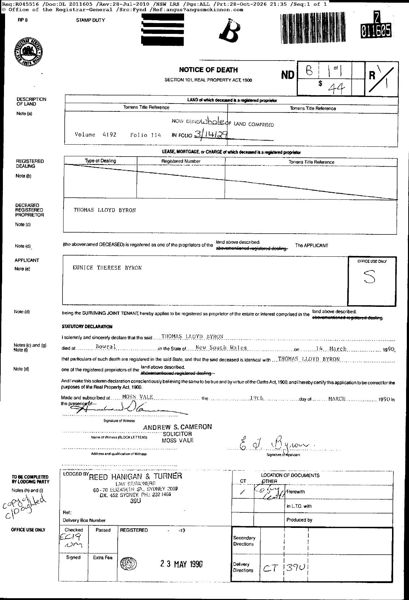
Z11605 Source: NSW Land Registry Services, via Fynd [32] - 1993 / 2000Eunice Therese Gooley - same proprietor
Eunice’s connection with 7 Lee Street spanned more than three decades. She and her husband, Thomas Lloyd Byron, bought the property together in 1977. After Lloyd died in 1990, Eunice continued as its owner.
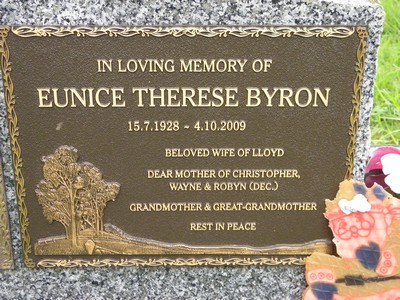
On 8 December 1993, Eunice married Cornelius Leonard Gooley at St Joseph’s Convent Chapel in Mittagong. Their marriage certificate, preserved with the property records, carries their signatures. Eunice later recorded her married name on the title and remained the owner until her death in 2009. Her memorial at Welby records that she was born on 15 July 1928.[39]
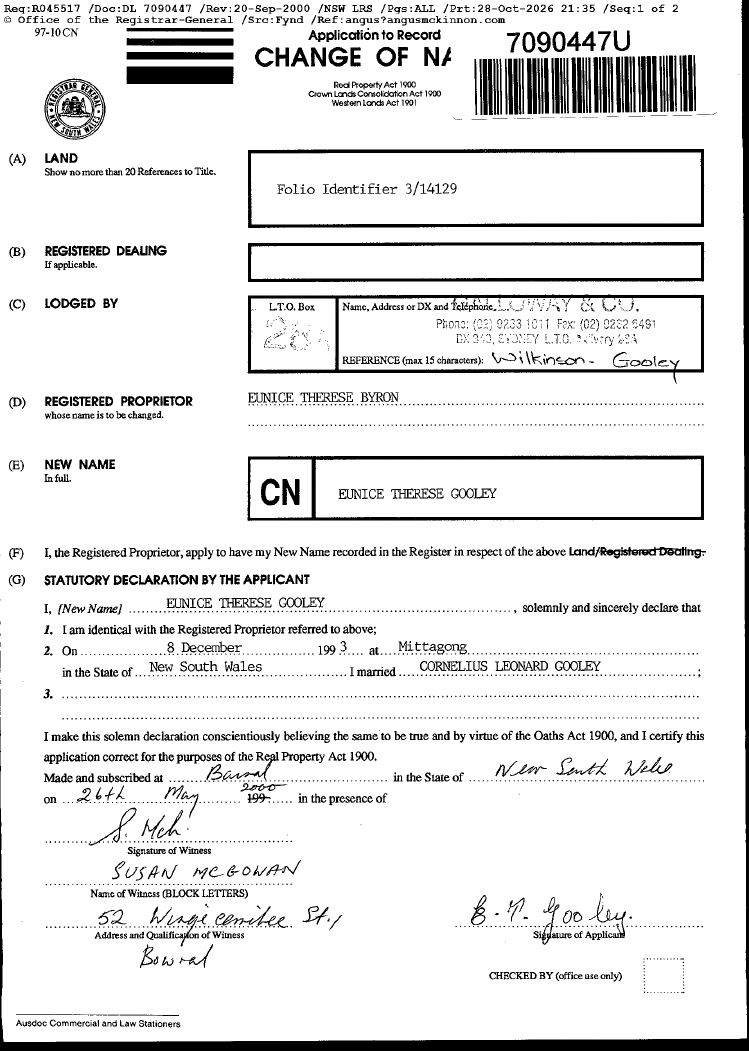
7090447 and marriage certificate Source: NSW Land Registry Services, via Fynd [33] - 2009Wayne Joseph Byron - executor
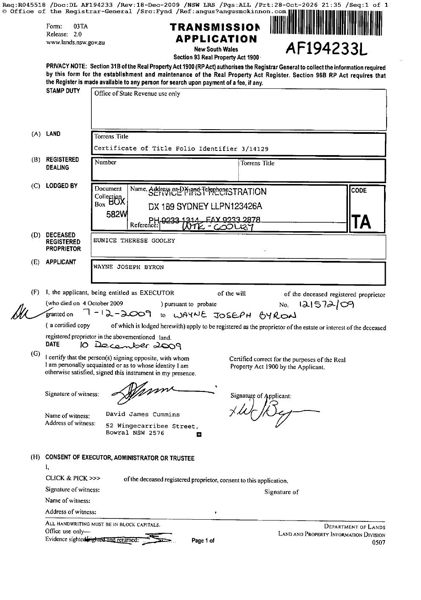
After Eunice’s death in October 2009, her son Wayne Joseph Byron became the registered executor of her estate. The memorials for Eunice and Lloyd remember Wayne as their son.[39][35] The property passed into the next chapter of its history the following year.
- 2010Merran Kingsford-Smith & Mark James Wasiutak
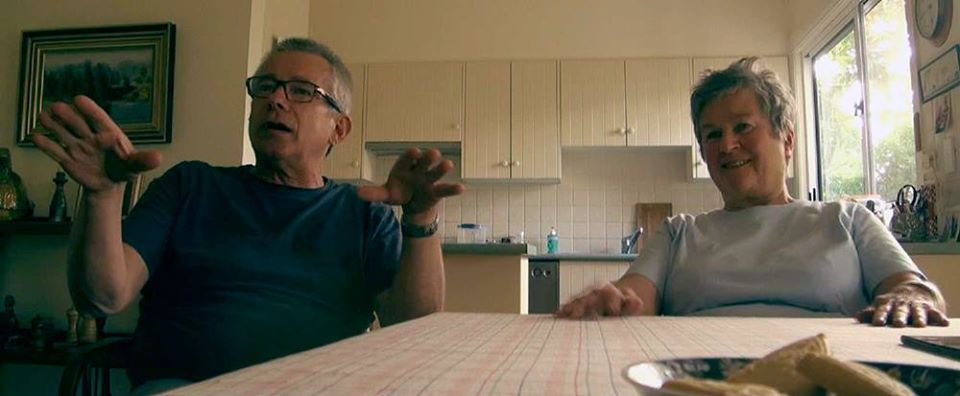
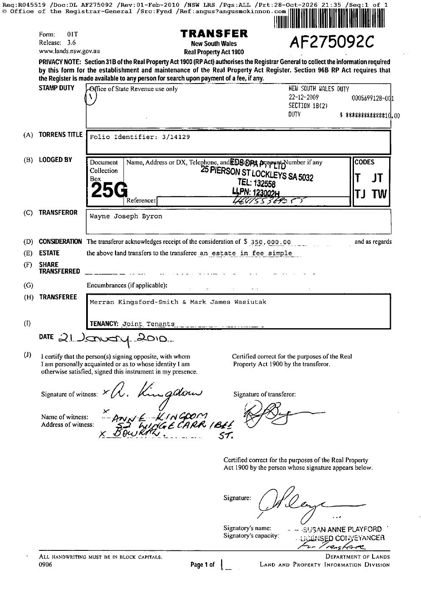
Mark Wasiutak and Merran Kingsford-Smith Source: Seriz [67] In January 2010 Merran Kingsford-Smith and Mark James Wasiutak bought the property together for $350,000.
There appears to be a remarkable film connection to this chapter of the house. The credits for the original Mad Max name Merran Kingsford-Smith in wardrobe and Mark J. Wasiutak as boom operator. A later retrospective pictures the two together. The matching names make this a promising connection, although the property records do not themselves record their occupations.[66][67]
Between the two films, Mark Wasiutak was part of the sound team on Ground Zero, the 1987 Australian thriller set against the background of British atomic testing. The team received the Australian Film Institute’s Best Sound award.[70]
Decades after the first film, sound mixer Ben Osmo described Mark J. Wasiutak working as the key boom operator on Mad Max: Fury Road. He followed the cameras across the production, recording sound and helping the team manage the demanding shoot.[69]
Merran also appears likely to have had a family connection to one of Australia’s best-known aviators, Sir Charles Kingsford Smith. Aviation historian records name a Merran as the daughter of Rollo Kingsford-Smith, a decorated airman who later lived at Exeter in the Southern Highlands. Rollo was Sir Charles’s nephew, which would make his daughter Merran the aviator’s great-niece. The matching name and local connection make this a highly likely link, though the records found so far have not conclusively established that Rollo’s daughter and the owner of 7 Lee Street were the same Merran.[71][72][73]
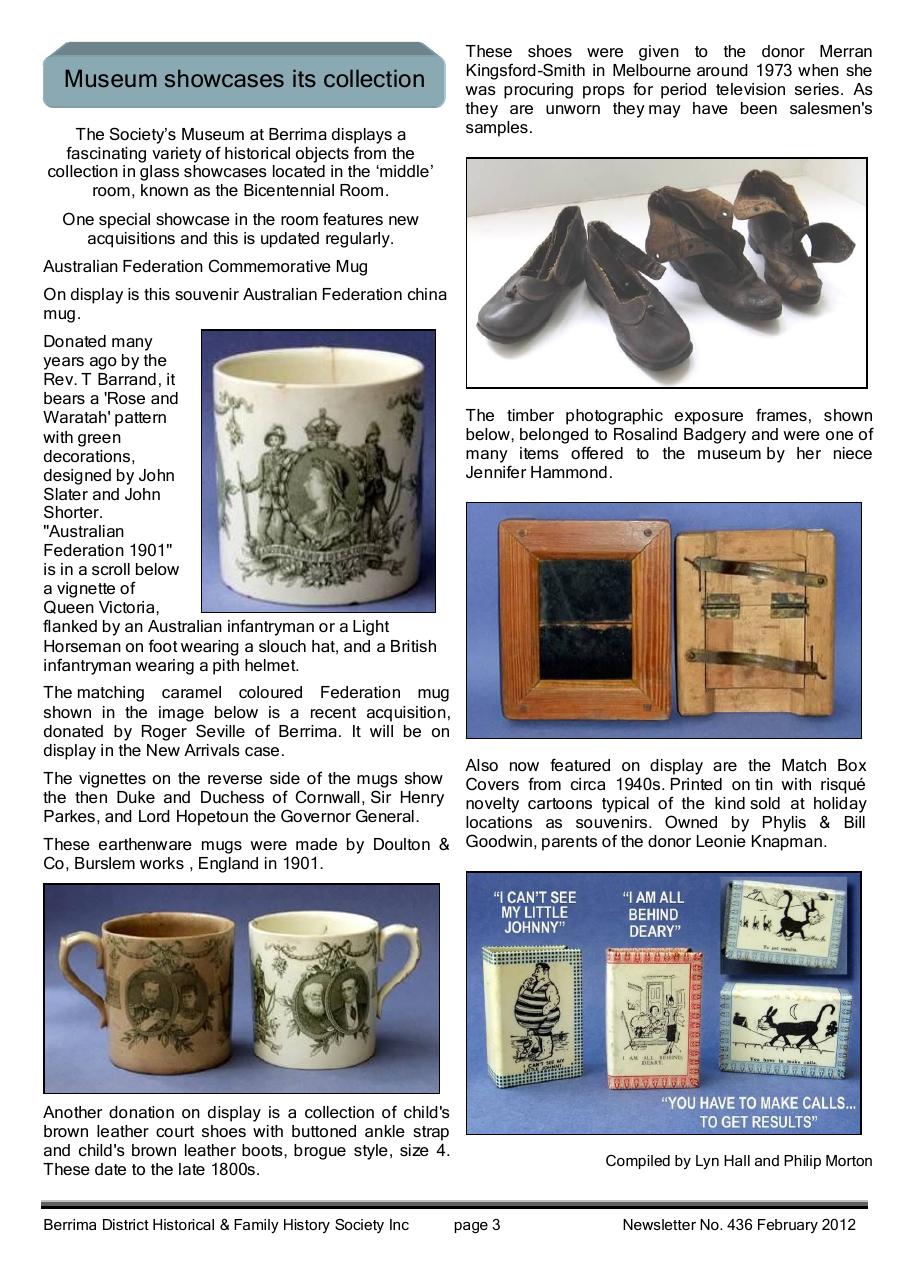
A Merran Kingsford-Smith also contributed a pair of historic children’s shoes to the Berrima District Historical Society. Its 2012 newsletter recalled that she had found them in Melbourne around 1973 while collecting props for a period television series.[68]
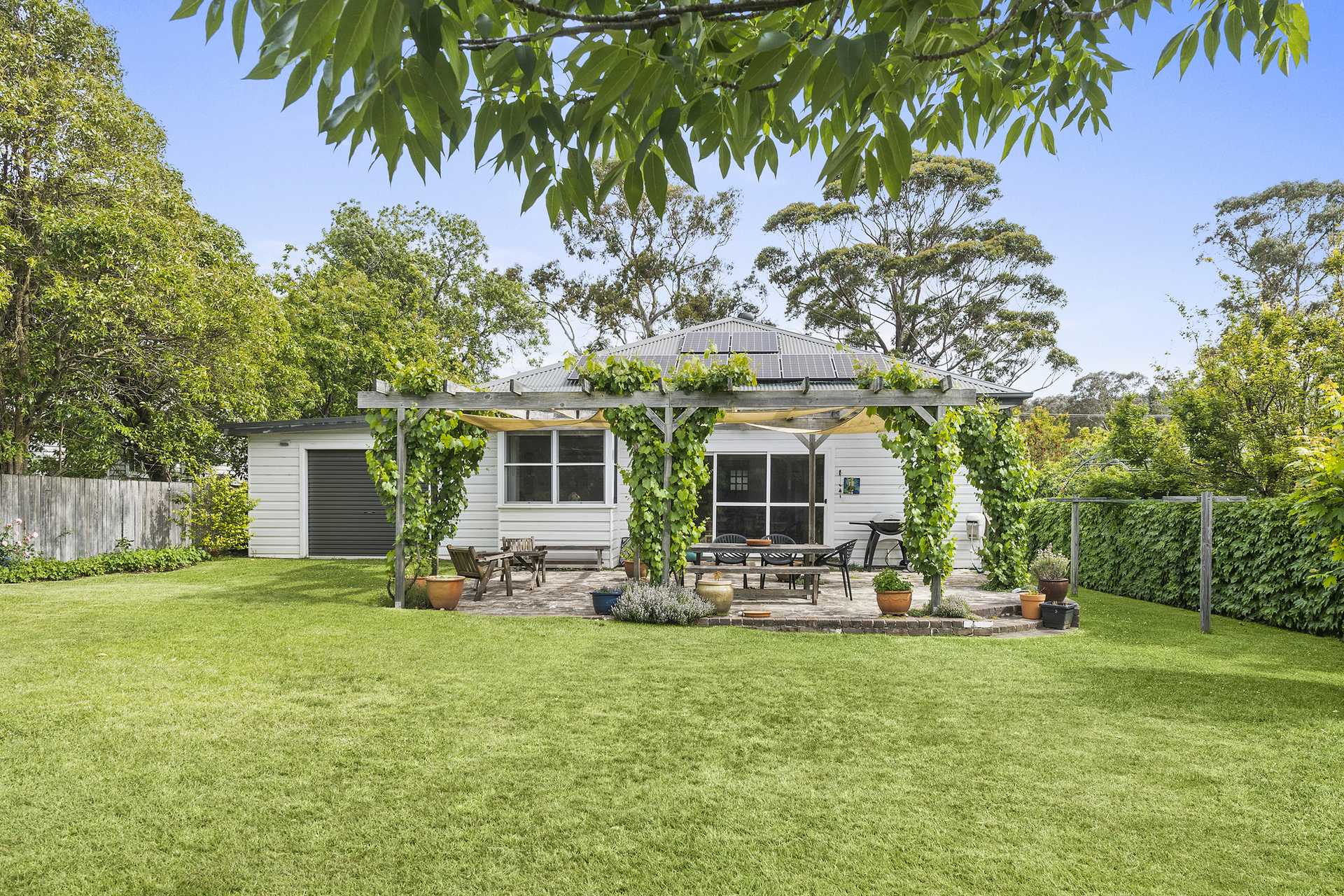
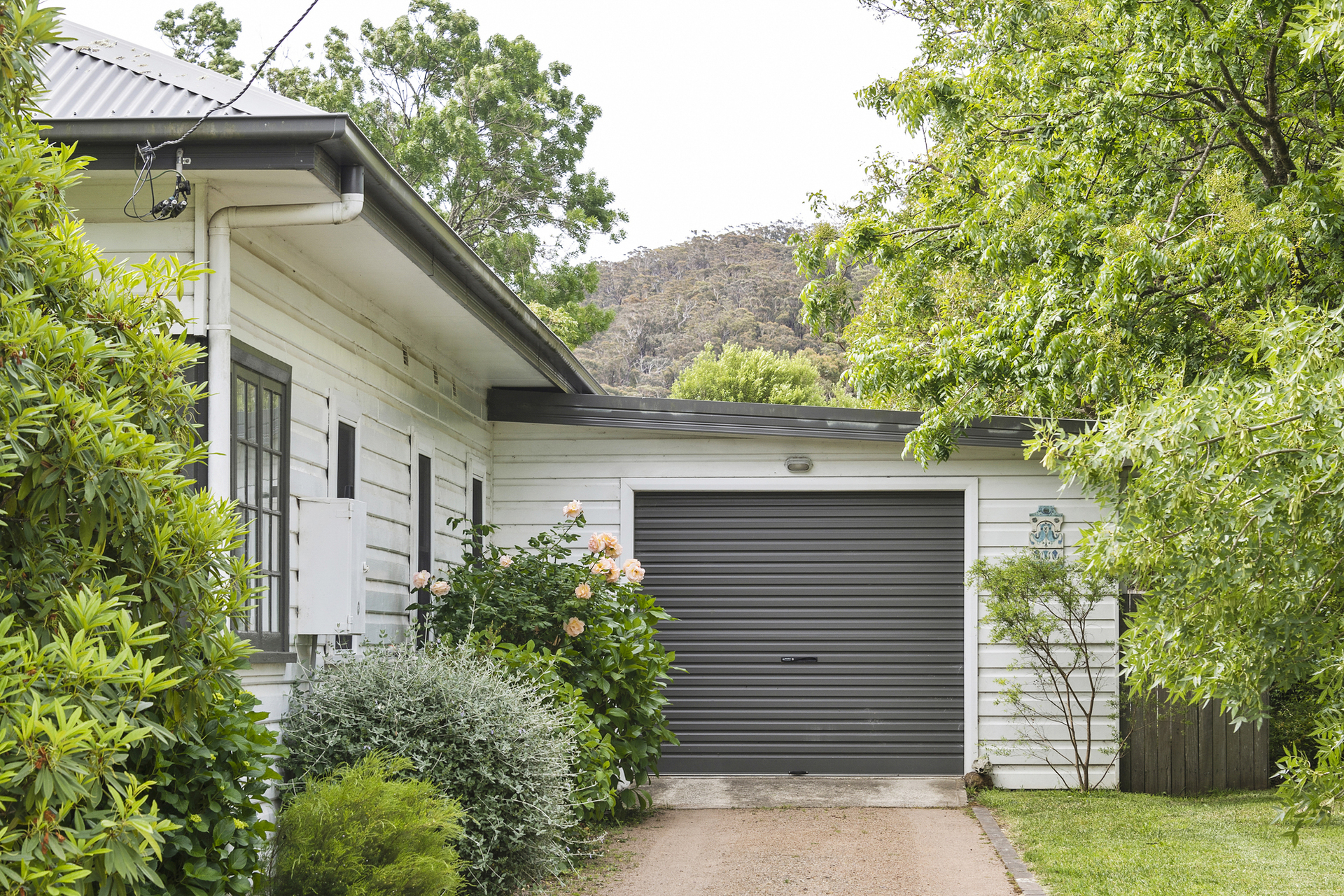
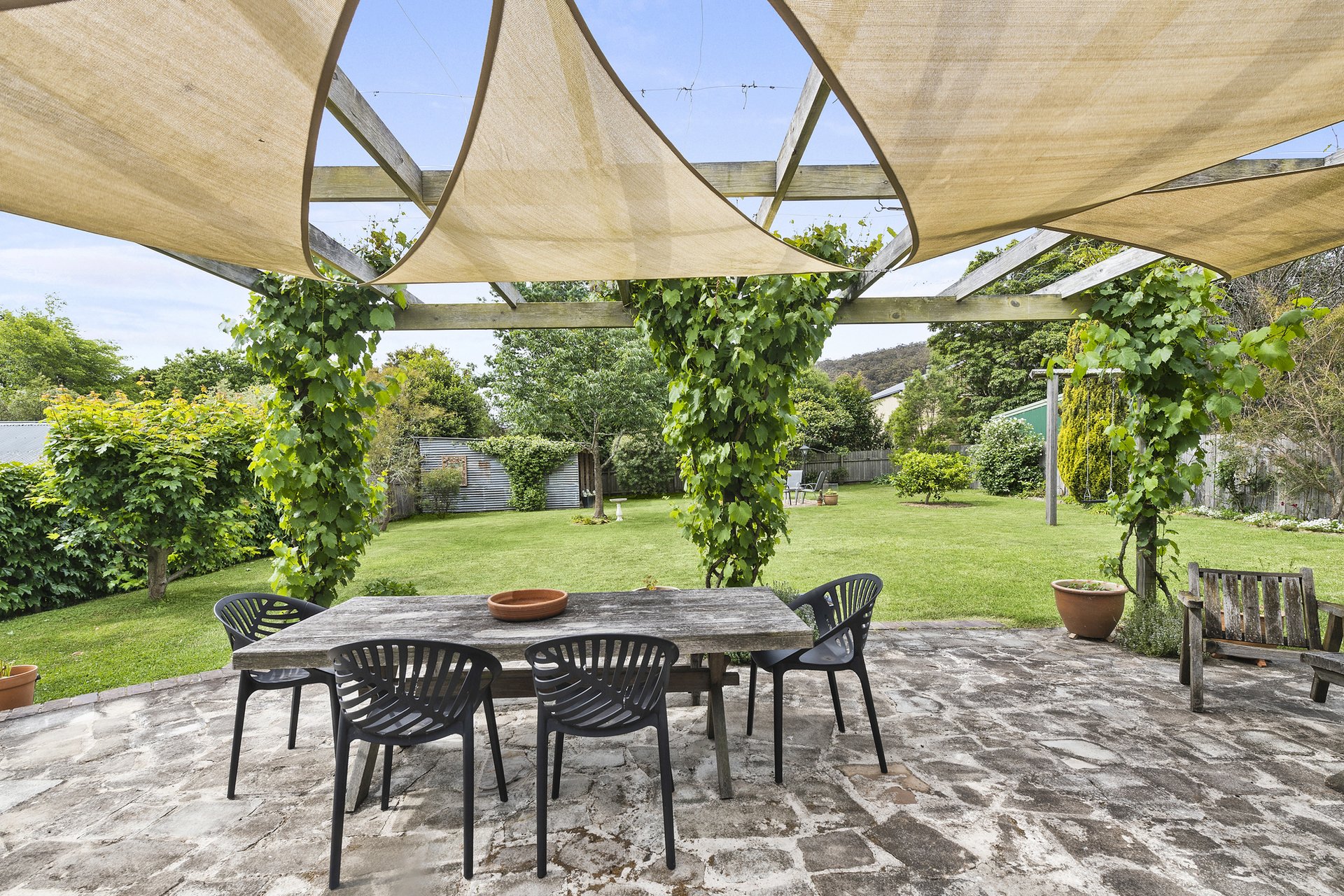
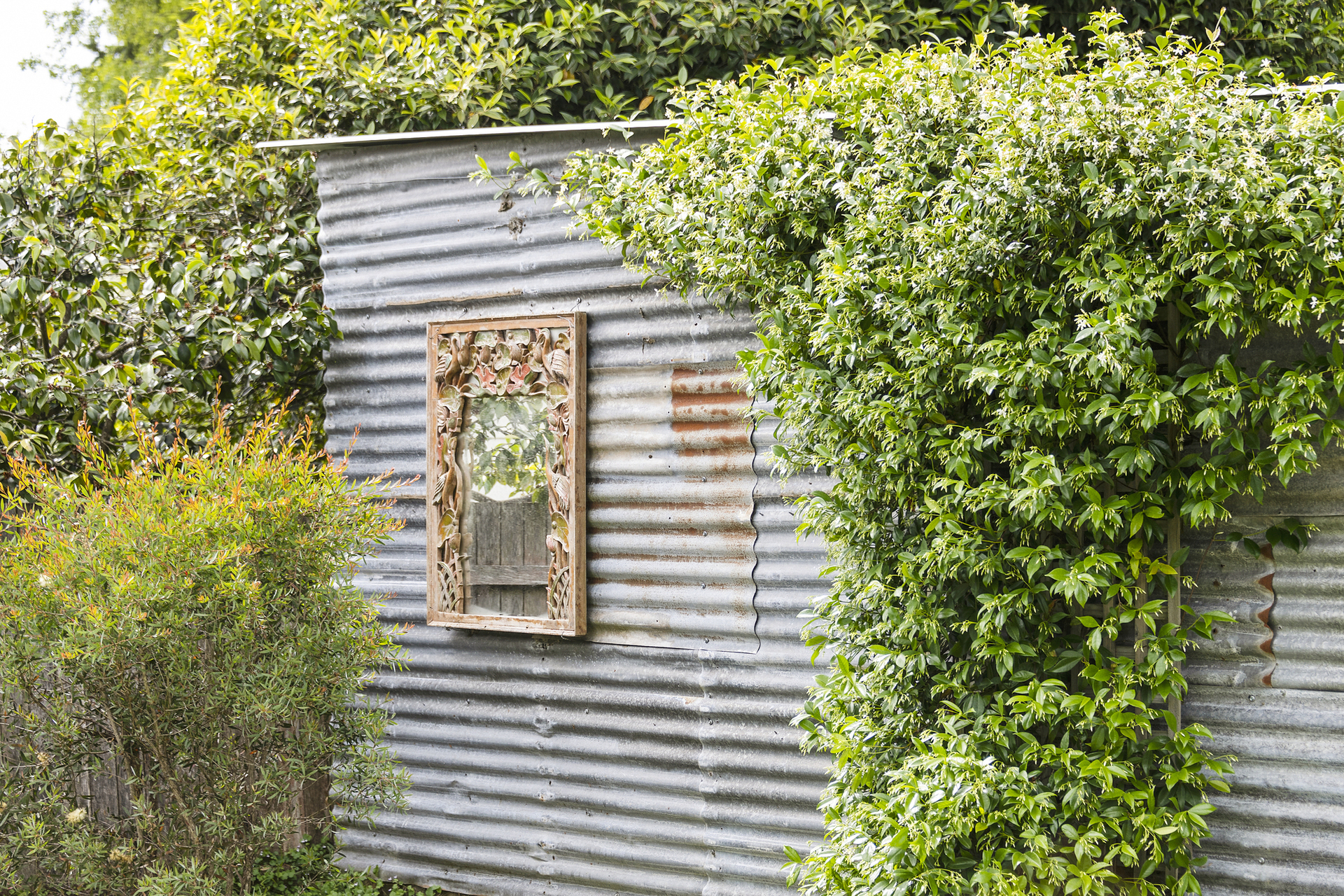
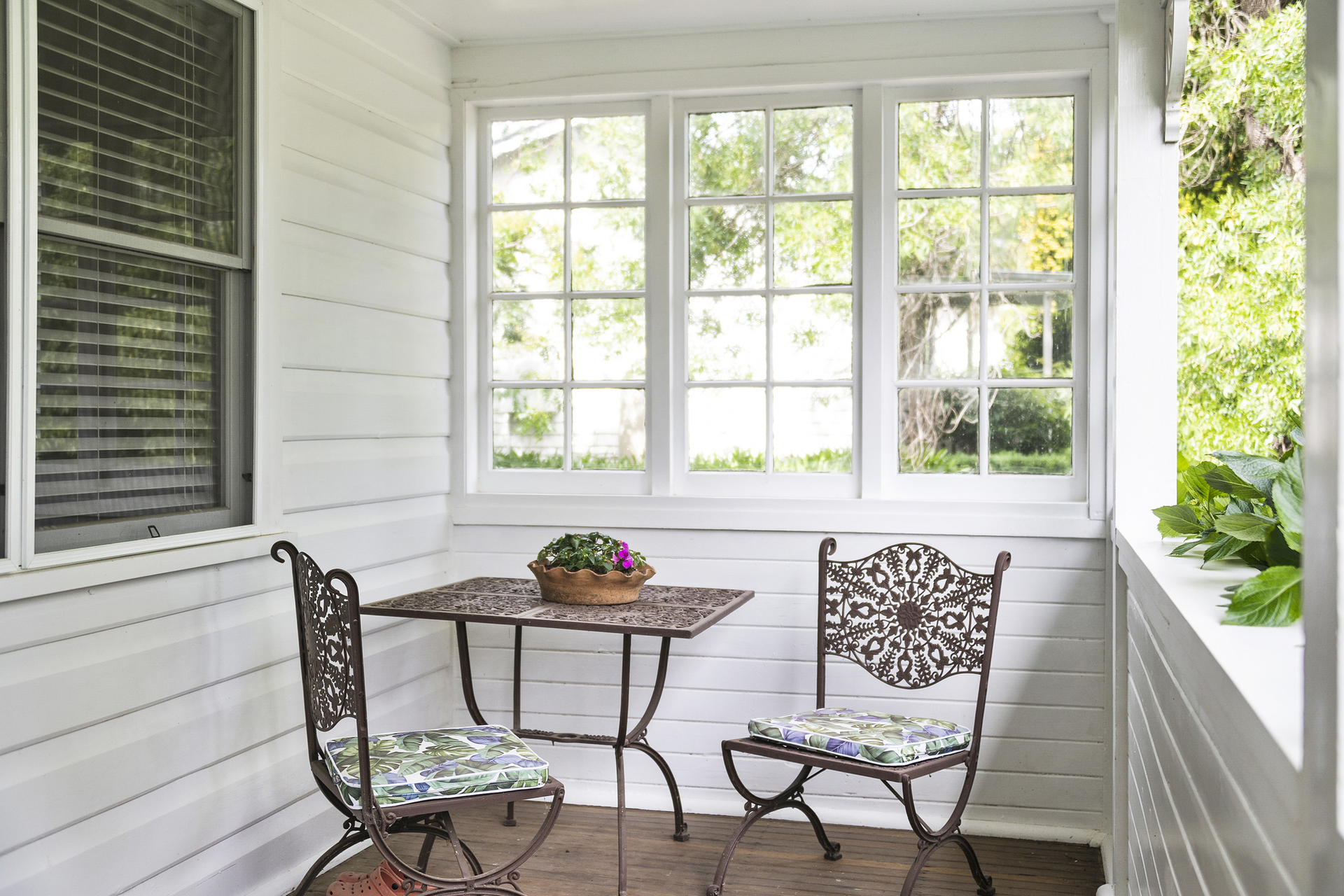
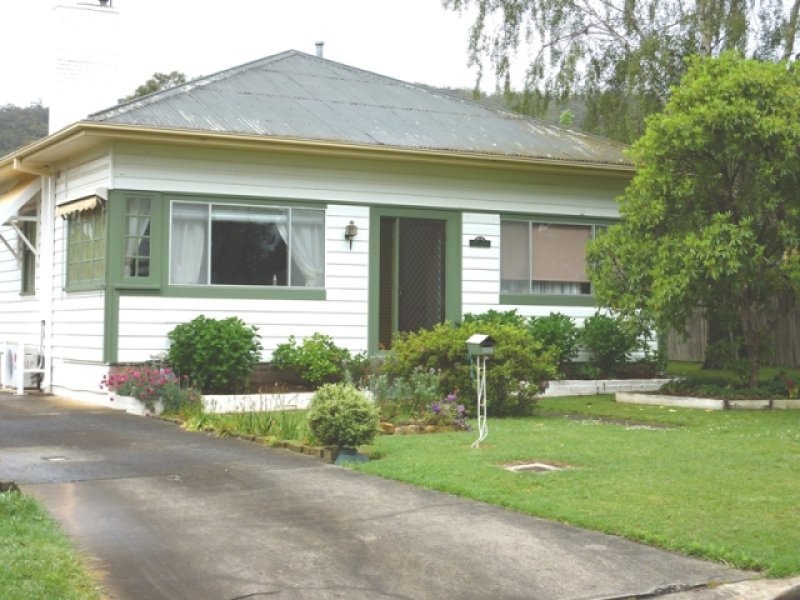
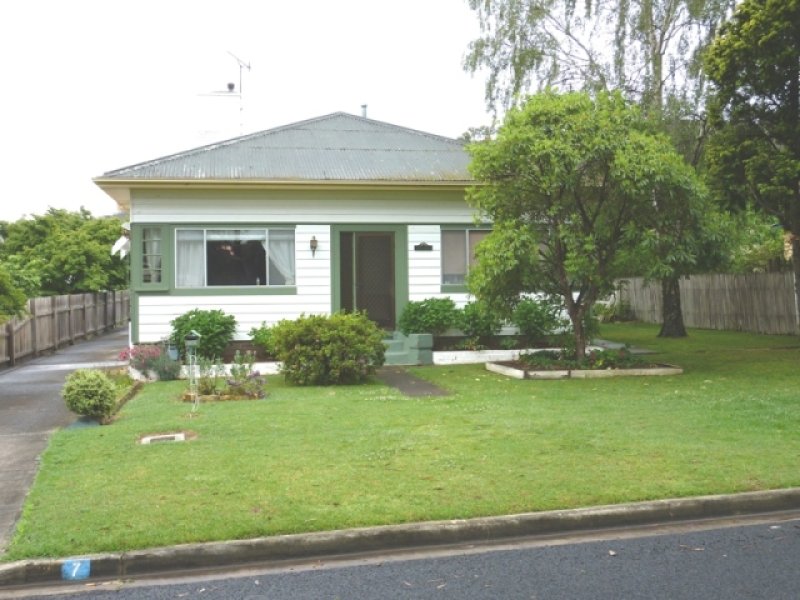
Photographs in the property gallery show the house before and after this period. The earlier view shows its weatherboard front, broad hipped roof and central doorway; in the later view, the entrance has a sheltered porch and the front windows and finishes have changed.
The following year, an insurance certificate was issued for structural alterations and additions to the dwelling, with 32 Degrees Building Pty Ltd named as the contractor.[40] The certificate records the proposed insured work.
- 2026-presentJulie Marina Searant
In March 2026 Merran and Mark transferred the property to Julie Marina Searant for $1,300,000, beginning the latest chapter in the story of 7 Lee Street.
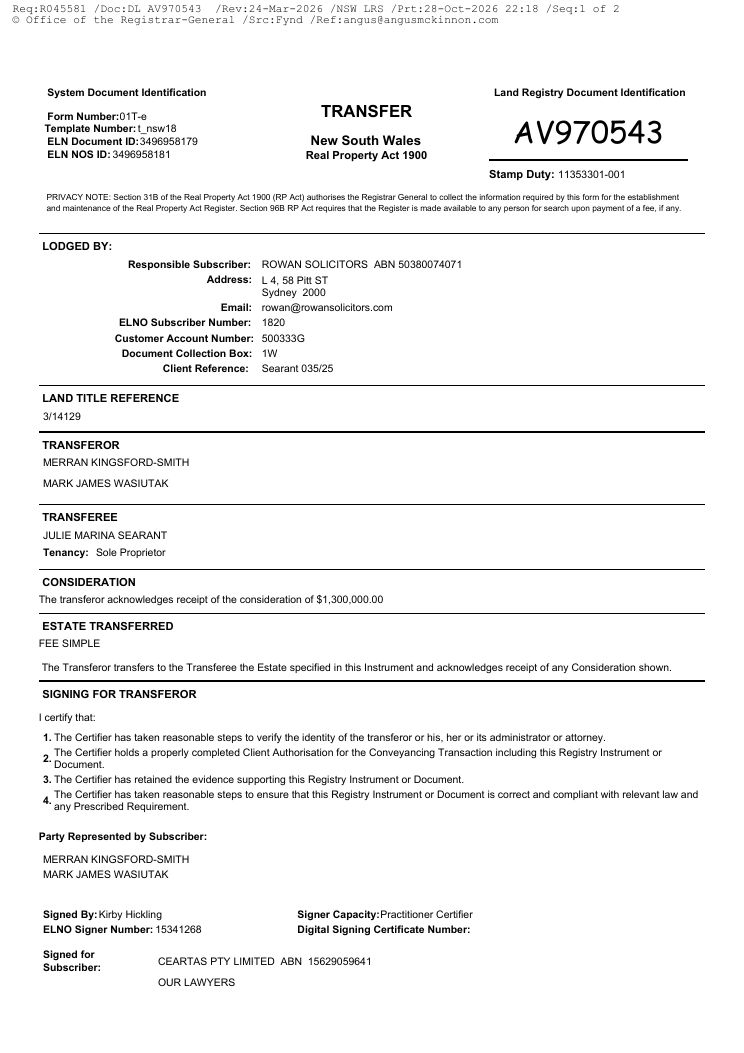
2026 transfer AV970543 Source: NSW Land Registry Services, via Fynd [37]
Mysteries We Would Like Help With
There is more to discover about The Cottage and the people connected with it. Photographs, family memories and records could help answer these questions.
- Who lived in the house during the War Service Homes years, particularly between 1928 and 1977?
- When was the house built, and was it the same cottage we see today?
- What was the property’s street number when this part of Lee Street was called Alfred Street?
- Why was the street named Lee Street, and was it named after Claude Newton Lee or his family?
- Are there earlier photographs, building plans, advertisements or stories of the house and its residents?
- Was the name “The Cottage” used in earlier years, and when did it first appear?
- Can the family and professional connections of the later owners be confirmed and their stories expanded?
- How did the 1870 sale of the ironworks relate to the 1871 transfer of the land to John Frazer?
Further Research Opportunities
These are offline research opportunities that mainly involve physically inspecting books, archives and other records for more about the people who lived in the house, when it was built, and its history. The Society’s library comes first, followed by collections grouped by location and arranged broadly in order of their likely value. Links to catalogues and digitised sources can help prepare for those searches.
For every search, use Lot 3 DP14129, 7 Lee Street, Mittagong, the subdivision plan, neighbouring lots and any assessment number. The section of Alfred Street west of Pioneer Street became Lee Street in 1972, but the house’s former street number is unknown. The present 7 Alfred Street is a different property. A ratepayer or subscriber is not necessarily an occupant. View subdivision plan
1. Berrima District Historical & Family History Society: library
Start with these titles and the Society’s library catalogue. The catalogue identifies holdings; the books have not yet been checked for this property.
- List of Rate and Valuation Books ex Mittagong and Nattai (R.13/114)
Use the inventory to locate Society-held rate books and their years and ridings. The catalogue says books are held in the safe. - What’s in a Name? The Streets of Mittagong (REF. 13/294)
Check Lee Street, Alfred Street and Sunset Point Drive, including sources for the 1972 renaming. - Guide to the Berrima District 1976-7 (R.13/107)
Consult its street directory for Lee Street and the neighbouring streets around 1977; check whether it lists residents. - Pride, Spirit and Enthusiasm: A History of Mittagong RSL Sub-Branch 1919-2019 (REF. 13/282)
Look for War Service Homes, housing assistance, veterans, names and photographs. - Celebrating 150 Years Mittagong Public School (R.11/62)
Look for school photographs showing the surrounding streets and local families. - Mittagong’s Picturesque History (R.13/75)
Check Sunset Point, Claude Lee, the estate, street views and photographs. - The History of Mittagong (R.13/211)
Search the local-history notes for the streets, estate and people connected with the property. - Mittagong Memories (R.13/74)
Check recollections of the neighbourhood and residents in the early twentieth century. - A Place to Remember: Burragorang Valley (25/07)
Read Claude Newton Lee’s book for his life and interests. It is not yet known whether it mentions the property. - The Story of the Fitzroy Iron Works (R.13/50)
Look for the companies, owners, land, photographs and additional sources. - Early Industries in the Mittagong District (R.13/68)
Check the ironworks, the landholding and associated businesses. - Mittagong and District: Its Industrial Development (R.13/25 or R.13/68A)
Check the ironworks and surrounding development. The 1940 journal continuation is available on Trove. - Centenary of Australia’s First Iron Smelting at Mittagong (R.13/50)
Check the 1948 souvenir for illustrations and industrial history. The catalogue uses R.13/50 for more than one title; confirm the volume.
2. Wingecarribee Library Archives and council records
The Local Studies collection at Old Bowral Town Hall holds council records. Check current access before visiting; the room was described as temporarily closed when last checked. Collection information
- Rate and valuation records. Start with Mittagong Series 8: 1971 valuation lists boxes 8/46-48 and 1972 listings and 1968 valuation numbers in 8/49. Follow the assessment back through 1960 boxes 8/21-22 and 1950 boxes 8/1-2; 1969 is 8/43-45, 1974 is 8/51 and 1975 is 8/52-53. Record names, owner or occupier, lot, improvements, value and assessment numbers. For earlier years check Mittagong Series 7, 1937-1938, boxes 7/1-2; and Nattai Series 9, selected 1939-1949 records and Society books for 1938-1943. Confirm council boundary, riding and actual volume labels. Series 8 · Series 7 · Series 9
- Former Alfred Street number. Check the 1964 street numbering register, Series 3 box 3/1, shelf 4/C, against Lot 3, neighbours and rate assessments. The catalogue’s series dates conflict with the stated register date, so confirm the volume with the archivist. The 1964 riding boundary proclamation may help select the right records, but has not yet been mapped to the lot. Numbering register finding aid · Riding boundaries · continued
- Building registers and plans. Locate the Mittagong registers for 1923-1925 and 1925-1948; search Lot 3, Claude Lee and the War Service Homes Commissioner for a building, date and applicant. Tim McCartney used these registers for the heritage study and may know their location. Check the 1934 Alfred Street weatherboard approval and 1947 J. F. Moxom Sunset Point application only if the lot can be matched. Ask council for historic plans, approval and inspection cards, and records of the insured 2011 alterations. Council property records · 1934 report · 1947 report
- Water, sanitation and services. Check 1969 water accounts in box 8/45, shelf 11/B, and Building Sanitary Services in 8/44, shelf 11/A. Look for septic applications and plumbing certificates, thought to cover parts of 1955-1972, and connection records. Compare lot, assessment, address, applicant and work dates; catalogues give conflicting certificate dates. Claude Lee’s 1948 request for a water connection concerned another, unidentified property occupied by W. Isedale; do not assume it was Lot 3. 1948 council report
- Council minutes and the street name. For the 1972 renaming, start with the 19 June meeting in Series 2 volume 2/23, shelf 3/D, and earlier correspondence or 1971 volume 2/22 for the reason and namesake. For the Commissioner’s purchase and any building or road work, check 1927-1929 in box 2/6 and 1930-1931 in box 2/7, shelf 3/A. Follow the May 1928 Alfred Street resumption plan, whose lots are not identified in the report. Minutes finding aid · 1928 report
- Gilham cottage and council files. Check Nattai minutes and building inspector reports in boxes 3/4 for 1945-1946 and 3/5 for 1947-1948, shelf 4/C. Look for the donor and lot of the 1948 cottage for Mrs Gilham. Her earlier cottage and the donated site must be matched separately; neither has been established as 7 Lee Street. 1948 completion report · 1946 inspector report
3. National Archives of Australia: War Service Homes
The Commissioner acquired the lot in 1928. A property file, loan or rent card, application or plan may identify the first household and building work. Catalogue descriptions do not establish that a record for this lot survives.
- Location and name indexes. Ask how to inspect A496 property location cards arranged by state and town, and follow any Mittagong reference into A3280 correspondence. A496 boxes 1-4, item IDs 11256150-11256153, were not digitised or examined when checked. A498 indexes applicants by name and becomes more useful once a likely resident is known. An online A3280 search for Mittagong, including notes, returned no match. A496 · A498
- Loan and rent cards. Ask how to search NSW series ST2366/1 and any unindexed cards by locality, street, lot or applicant without a J-number. Item 1107307 was listed open in Sydney, without a digital copy; no number for this property is known. Also ask which surviving series contain home-loan files, security registers and card indexes described in DVA records authority classes 16323-16325. ST2366/1 · Records authority
- Plans and site maps. Ask whether unlisted Mittagong records occur in C2311 house and block plans, or SP205/5 War Service Homes site maps. The listed descriptions checked did not identify the property; a plan could help date or locate a building. C2311 · SP205/5
- Veteran and repatriation files. Once a likely resident is identified, check their service file for post-war addresses or housing applications. Ronald George Gilham’s digitised file B883 NX42204, item 4898302, gives a 1940-1941 Berrima Road address but no later cottage address; A8231 item 32566159 is a further burial-related file. The widow’s initials vary between sources and the donated block is unlocated. Gilham service file
- Claude Lee’s deposited book. A1336/65491, item 5159238, is his 1964 copyright registration for A Place to Remember, listed open in Canberra with a work enclosed. The Society’s 1971 copy is the closer first option.
Confirm reading-room access and copying prices before arranging a visit or order. Free inspection or personal photography may be possible subject to the Archives’ conditions. Archives copying information
4. Society archives, RSL and local newspapers
- Housing and tenancy. Search the Society, Mittagong RSL and Nattai-Bowral Repatriation Committee files, minutes, case correspondence and tenancy referrals for the lot, both street names and a possible veteran. A 1947 report says the committee assisted with War Service Homes and cottage tenancies but does not name this house. Committee report
- Gilham family and cottage. Check 1946-1948 committee, RSL and council records for the donor, lot, address and widow’s name; seek a clearer copy of the 1948 cottage photograph. Reports differ in the widow’s initials and number of children. The cottage cannot be linked to 7 Lee Street without a lot or address match. Cottage photograph · 1946 appeal
- Newspapers and sales. Search Society newspaper indexes and surviving Mittagong Star issues, especially 1927-1932 and 1956-1960, for the estate, Lee, the Commissioner and residents. Look for the 1926 Sunset Point auction lithograph, Burton of Bowral’s exhibited panoramic photographs and sale results. The 1927 advertisement does not identify whether Lot 3 sold. 1926 auction notice · 1927 advertisement
- Photographs and biographies. Check the Haydon glass-plate collection, building and family files, and images of the estate, school and Lake Alexandra. Image-library items 107942 and 107039 are early views from Mount Alexandra; neither is matched to the lot. Byron items 107184 and 100692, and bowling items 106598 and 102843, need captions and identity checks before linking anyone to the house. Society image library
5. Electoral rolls and telephone directories
After identifying the former number, search Alfred Street and neighbours before 1972, then 7 Lee Street. Use names and rate assessments to cross-check the lot.
- Society and local libraries. Check the Society’s 1967 Macarthur roll R.02/49 for the Mittagong subdivision and 1974 Mittagong B Riding ratepayers’ roll R.02/46 after establishing the riding. Other Society rolls include 1973 R.02/37 and 1978 R.02/45; verify subdivision coverage. Wingecarribee libraries list Ancestry access and local rolls; browse 1937 Werriwa/Mittagong and available 1930-1980 rolls. Findmypast lists 1935 Mittagong, subject to access. 1937 catalogue entry
- Wagga Wagga and the National Library. Wagga Wagga District Family History Society lists Mittagong rolls 1928 KH35/7296, 1929 KH36/7297, 1951 KH37/7298 and 1969 KH38/7299, shelf 20/C. The National Library lists NSW rolls on microfiche including 1970 and 1972-1979; confirm the subdivision before searching. Wagga guide · National Library guide
- Telephone and postal directories. Check Ancestry Australian telephone directories 1913-1959, National Library NSW Country Telephone Directory microfiche mc N 1309, and relevant Mittagong exchange years at Hawkesbury, Woollahra or Charles Sturt University. Gold Coast Family History Society lists 1986 and 1993 Mittagong directories at C576/591; confirm a closer copy and current holdings. The 1948 postal directory was checked and lists businesses without a useful lot match. Ancestry collection · Gold Coast catalogue
6. State Archives, State Library and other collections
- State valuation records. Ask Museums of History NSW whether Mittagong or the relevant riding survives in Valuer General rolls NRS 14465, field books NRS 14467 or valuation cards NRS 14466. These may record a lessee, improvements and value; item coverage remains unconfirmed. Land valuation guide
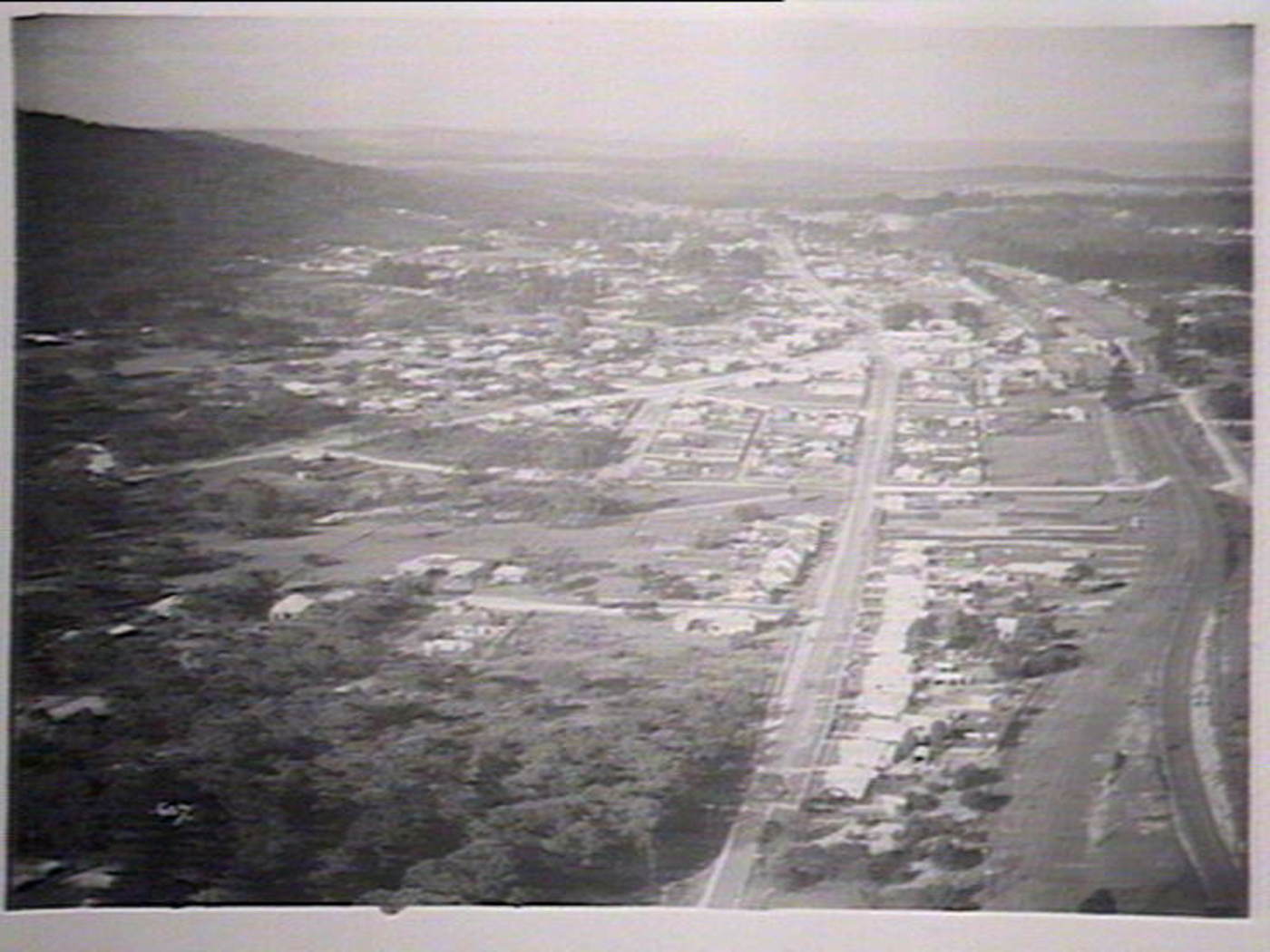
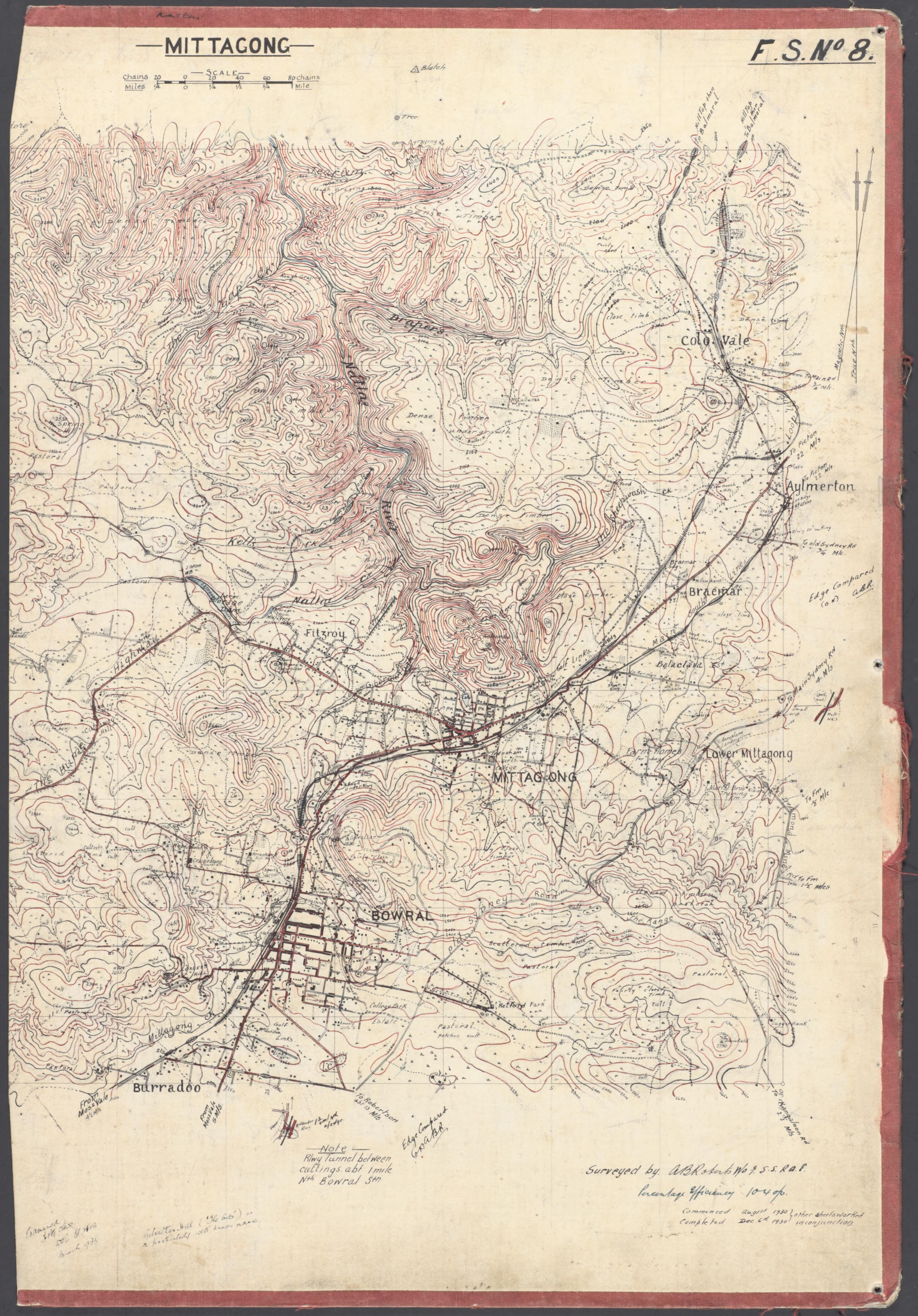
- Maps and early photographs. Compare DP14129 with the 1925 Sunset Point photograph, Government Printing Office 1-01300, digital order d1_01300; the State Library says the original negative is held in State Archives NRS 21689/NRS 4481. Check the 1930s Mittagong aerial 1-07248 and the National Library’s 1930-1933 plane-table survey sheet 8; the lot is not yet positively located in either. Ask State Archives and Transport NSW about 1957-1958 road-survey aerial runs and frames. 1925 photograph catalogue · 1930s aerial · Survey sheet
- Commonwealth Bank archives. Ask whether local War Service Homes application, insurance or day-book records survive and can be searched by property. The bank’s historical account describes its role but does not establish that it handled this house. Bank archive history
- 1870 auction and 1871 transfer. Seek Richardson & Wrench auction particulars, Fitzroy Iron Works liquidation records and the bank’s mortgage-release records. The 1870 newspaper reports £10,000 for the estate and plant without naming the buyer; the 1871 Frazer deed records £5,000 for specified land. Establish how the transactions relate before combining the figures. 1870 report · 1871 transfer
7. People and remaining cross-checks
- Thomas Lloyd Byron. Compare family records, addresses, photographs, bowling and Makatak records with the 1947 footballer Lloyd Byron and the 1962 Makatak founder. The 1950 obituary of Thomas Joseph Byron mentions a son Lloyd at Mittagong; a secondary family chart is a lead, with a conflicting reported death date. None alone proves these are the house owner. 1947 football report · 1950 obituary
- Eunice, Cornelius and Wayne. Eunice and Lloyd’s memorials name Wayne as their son; the estate transfer identifies him as executor. Check additional family records if needed. A 1978 patent names Cornelius Leonard Gooley, but his identity as Eunice’s husband requires an independent occupation or address match. Patent lead
- Merran Kingsford-Smith and Julie Searant. Confirm whether the former owner Merran is Rollo Kingsford-Smith’s daughter and Sir Charles’s great-niece; the name and local connection are promising but the identification is not proved. Check whether the separately found Julie Searant family-history and sporting records belong to the present owner before adding them to her story.
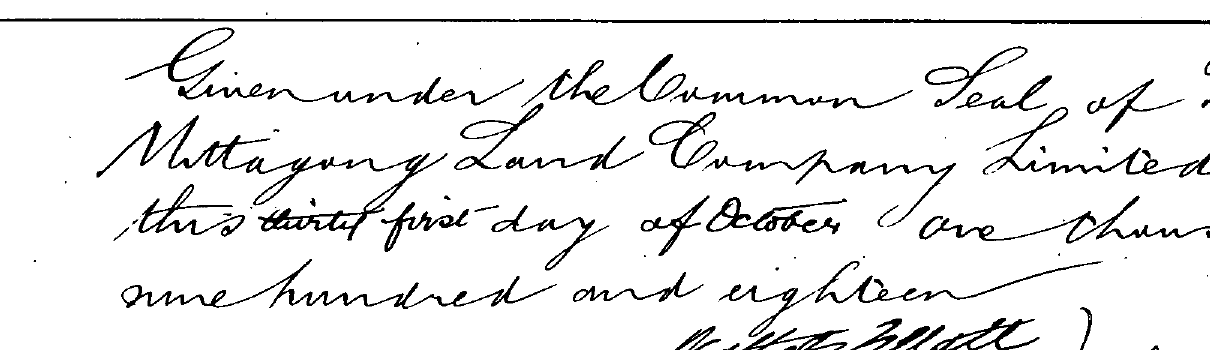
- Other property clues. Re-read the altered signing date on page 2 of 1918 transfer A430533; the 21 December 1918 registration is clearer. Use the 1928 Sunset Point bushfire and 1933 Alfred Street references to orient neighbours only after matching their properties. 1918 date detail · 1933 report
When recording a result, note the repository, series, box, volume, date, page or assessment, the property description and each person’s role. Keep copies where permitted and distinguish a confirmed lot match from a possible lead.