July 2015
Contents
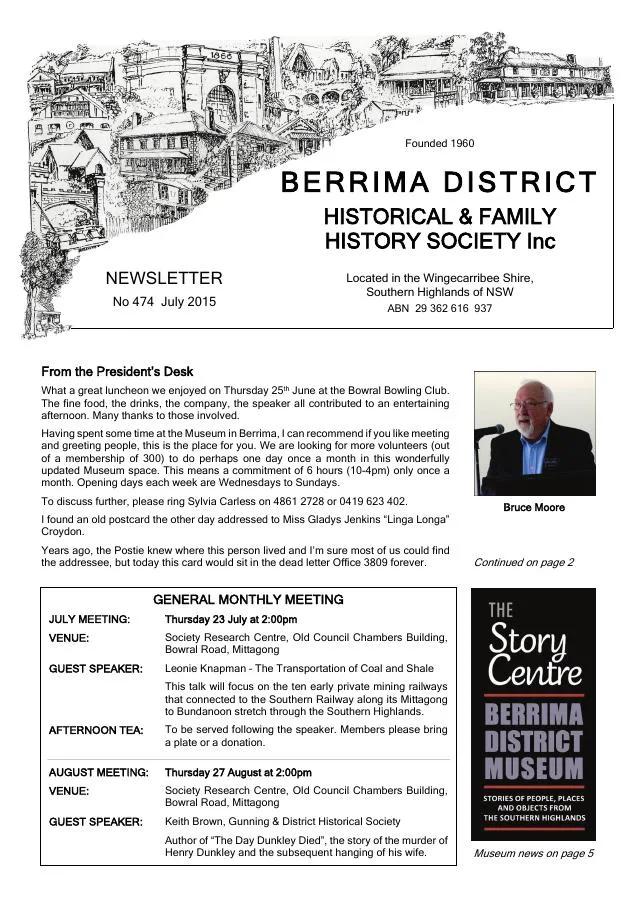
- President’s column and meeting notices - page 1Reports on a Society luncheon and announces a talk on local mining railways.
- Society notices and early newspapers - page 2Records an honour for museum adviser Desmond Kennard and reprints a 1931 notice seeking tenders to lease Berrima Gaol.
- Coal and shale transport by rail - page 3Introduces Leonie Knapman’s research on private mining railways connected to the Southern Railway and reports Penny Olsen’s natural-history talk.
- New books in the library - page 4Lists recent library additions, including local histories, Bundanoon photographs, Mittagong’s Wesleyan history and Louisa Atkinson’s nature writing.
- Wartime nursing and Red Cross collections - page 5Michele Woods describes the Southern Highlands 1200 exhibition, Burradoo Convalescent Hospital photographs and objects associated with nurses and Red Cross volunteers.
- The Collett Papers at Mittagong - page 6Frank Nevill traces the recovery of James Ralph Winsor Collett’s papers and his family history, including civilian internment in Singapore during the Second World War.
- Book sale and Mount Gibraltar quarry memorial - page 7Reports a Society book sale and describes the trachyte entrance wall commemorating Mount Gibraltar’s quarrying history.
- Society information - page 8Contact, opening, membership and committee information printed in July 2015; details may have since changed.
Issue highlights
- Leonie Knapman’s research introduces the private railways used to move coal and shale to the Southern Railway (p.3).
- The museum’s wartime exhibition includes Burradoo Convalescent Hospital photographs and objects associated with nurses and the Red Cross (p.5).
- Frank Nevill traces the recovery of the Collett papers at Mittagong and a family history extending to wartime Singapore (p.6).
- The issue records a 1931 tender to lease Berrima Gaol and describes a trachyte memorial to Mount Gibraltar quarrying (pp.2, 7).
Original Society source
Explore places in this issue
Follow places named in the contents into their local histories.
Keep exploring