Discover Exeter
Railway cottages, a school, shops and a church helped turn part of the Vine Lodge estate into the village of Exeter in the 1890s.

Explore nearby and connected places: Bundanoon · Sutton Forest · Penrose
Exeter through time
Vine Lodge and the beginnings of Exeter
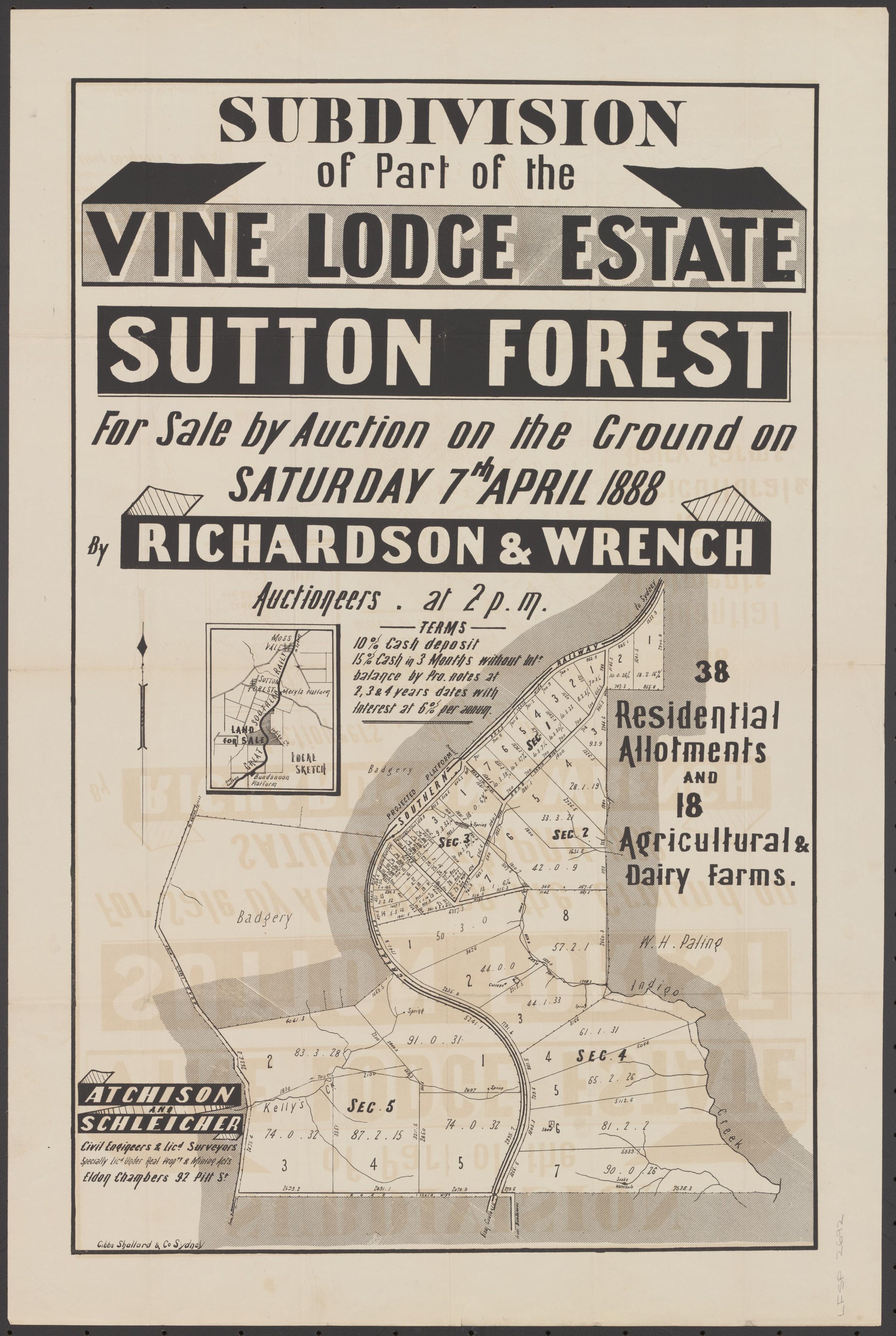
Heritage NSW dates the development of Exeter village to 1889 and describes subdivision of part of the Vine Lodge estate in 1891. The record associates the area with the Badgery family and notes that land was sold for both town and farm lots. By the early 1890s cottages, a post office and houses for railway staff were part of the growing settlement.[10]
Exeter Public School opened in May 1891 with John Cameron as its first teacher, according to the heritage record. The account also records a brick store in 1894, a bakery in 1895 and an Anglican church begun in 1895 and dedicated the following year. These dates offer starting points for researching the families, businesses and buildings behind village life.[10]
An October 1895 newspaper advertisement offered about 44 acres at Exeter among a wider list of farms in the district, including properties on the Vine Lodge estate. The advertisement provides a dated lead for land and subdivision research; it does not record a completed sale.[16]
St Aidan’s grew with the village. A Society history based on Linda Emery’s Exploring Exeter describes the first church, built of local basalt and Bundanoon sandstone and dedicated in January 1896. Seed merchant Arthur Yates, who had established a farm on the Vine Lodge subdivision, contributed to an enlargement fund in 1902; a new nave’s foundation stone was laid in 1903 and the enlarged church consecrated in 1911. Memorial windows and tablets connect the building with the Badgery and Yates families, while later alterations reflect continuing community use.[14]
Railway and wartime
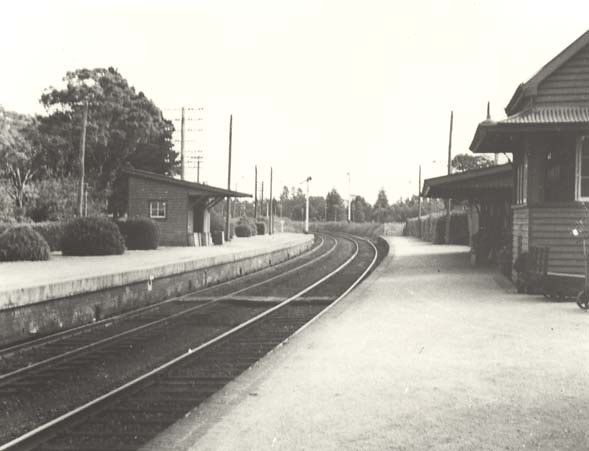
The village remembers the 1914 Exeter railway collision, when the Temora Mail and a goods locomotive collided near the station. The Society reported a centenary memorial gathering in 2014 and the involvement of local people and railway workers in the response.[9]
The First World War Kangaroo recruitment march passed St Aidan’s Church in Exeter on 30 December 1915, according to a Society account. The marchers continued towards Hillview and Moss Vale. In 2015 a centenary re-enactment followed the route; the newsletter places photographs of the original march and the re-enactment side by side at the church entrance. The issue misprints the re-enactment’s year in its caption text, so that date should be checked against other records.[12]
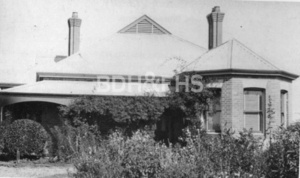
During the First World War, the Southern Home at Exeter was one of three district convalescent homes described by Society archivist Linda Emery. Volunteers trained as Red Cross voluntary aids cared for recovering servicemen. Emery records that the Society archive holds photographs of the homes, providing a lead for research into their staff and patients.[13]
The State Library’s Camden County list includes the 19 February 1916 subdivision of part of Vine Lodge Estate (Z/CP/C1/143 and Z/CP/C1/175). These catalogue entries identify land offered for subdivision, not a confirmed record of completed sales.[11]
Exeter also welcomed holidaymakers. Council’s history records Cooeeyana, a twenty-room guest house in Middle Road, serving visitors including Sydney business and professional people until around 1950. It was destroyed by fire in the early 1950s.[19]

A community remembers and grows
Council heritage material records that Exeter’s Soldiers’ Memorial opened on 22 November 1922 as a brick hall in St Aidan’s grounds. The School of Arts hosted a library, annual flower show, concerts and films in the 1920s, reflecting the importance of horticulture and community institutions. Electricity reached Exeter in 1929; a CWA branch formed in 1946 and opened rooms in 1955. The same source records nearby commercial quarrying from the 1950s. Together these milestones show a village shaped by rail-era settlement, horticulture, civic life and extractive industry.[8]
The School of Arts found a permanent home through local effort. Arthur Yates, Frank Nelson Yarwood and Frank Badgery bought a half-acre site in 1901; the hall opened with a concert in December 1902. During the Second World War the Australian Army briefly used it as a workshop and recovery depot. It later returned to community use as Exeter Village Hall.[18]
Exeter Park also began as a community undertaking. Council’s heritage survey says the land was bought in 1911, with half the money raised by public subscription and the balance provided by government. The memorial gates unveiled in 1950 became part of a park the village had helped establish.[19]
The school grounds also preserve a memorial landscape. Heritage NSW records a 1951 jubilee beautification scheme in which trees, shrubs and roses commemorated deceased pupils and residents; sweet gum trees honoured former pupils who died in the two world wars. Exeter Park has its own memorial gates, unveiled in 1950.[10]
The Society’s 2009 archives report identifies a valuable research lead: the Badgery family of Exeter allowed the Society to copy approximately 450 photographs, including farm and station scenes from the 1870s and 1880s. Its conservation report also describes work on fragile Badgery family maps. These reports identify collection material rather than establishing that every image or map is available online; consult the Society about access and individual items.[15]
Browse local photographs linked to Exeter
Explore the Society’s photographs for sale
Read the landscape
1916
Catalogue entry only; the original plan has not yet been inspected.
Vine Lodge Estate subdivision, Exeter
The State Library lists a subdivision of 41 acres from the estate of F. A. Badgery, on Old Bundanoon Road, for auction on 19 February 1916. This is a catalogue lead; inspect the original plan and title records to establish individual lots and sales.
Related places: Exeter
State Library of NSW, Camden County subdivision plans, Z/CP/C1/143.
Check the State Library item record for access and reuse conditions.
Browse maps and plans linked to Exeter
Newsletter Mentions
Stories about Exeter in the Society’s newsletters.

February 2023
- Recent Society publications cover Exeter, Mittagong street names, early Berrima, Aboriginal history and the First World War internment camp (p.7).


August 2018
- The Society marks 150 years of the Moss Vale-Marulan railway, which served the later villages of Exeter, Bundanoon, Penrose, Wingello and Tallong (p.3).
November 2015
- Members visit Browley and Oldbury near Sutton Forest; photographs compare the 1915 Kangaroo recruitment march with its centenary re-enactment at Exeter (p.3).
April 2015
- Linda Emery describes the Southern Highlands 1200 exhibition, local families and wartime convalescent homes at Burradoo, Moss Vale and Exeter (pp.4-5).
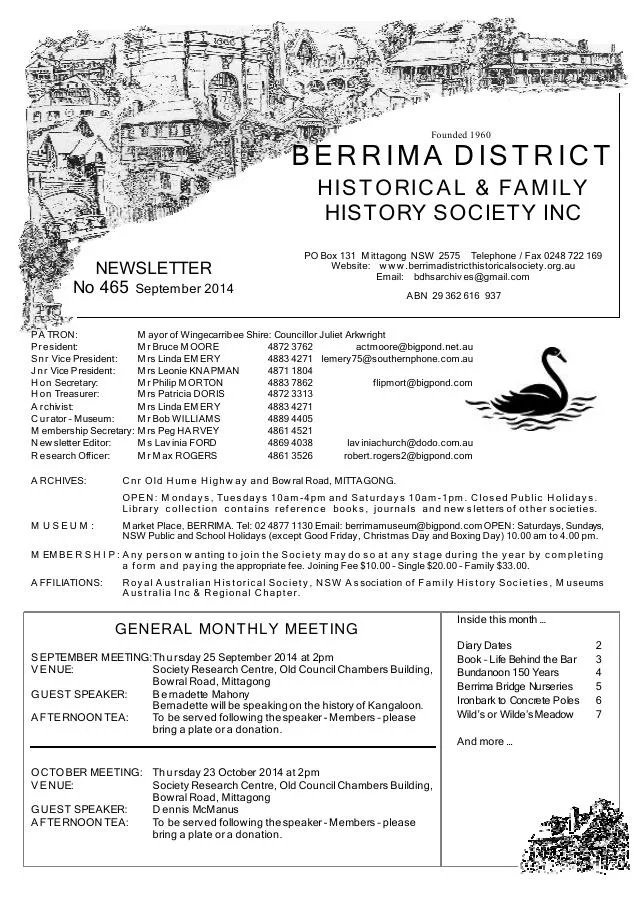
September 2014
- The issue recalls the 1929 electricity connection to Bundanoon and Exeter and reproduces a 1929 discussion of the name Wildes Meadow (pp.6-7).
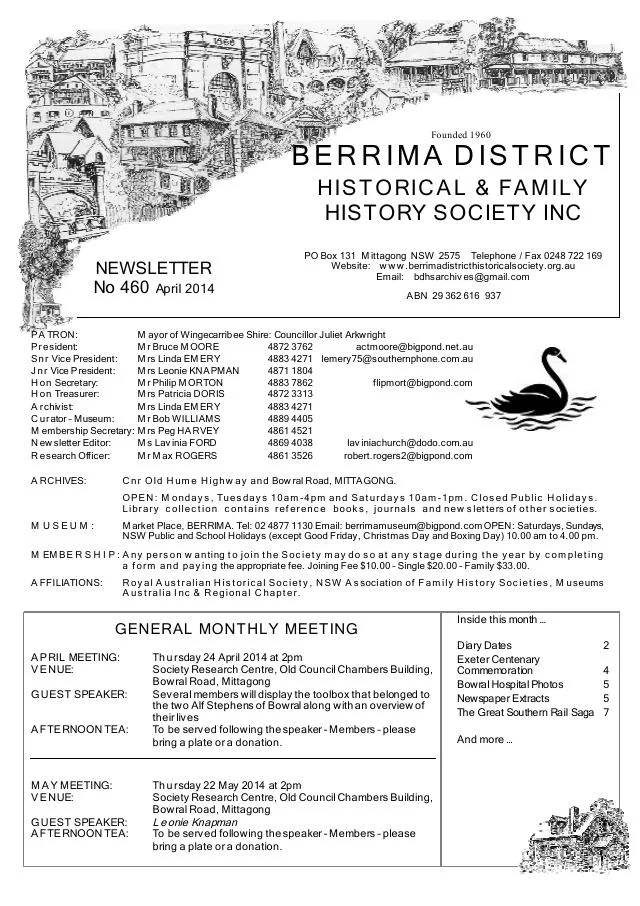
April 2014
- A centenary service and station plaque commemorate the 1914 Exeter railway disaster (p.4).
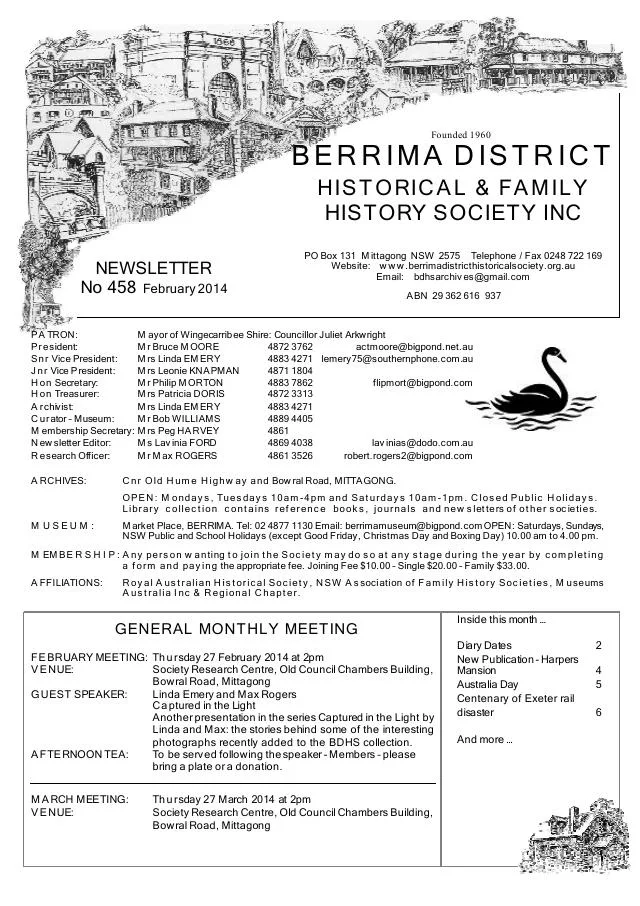
February 2014
- Linda Emery recounts the 1914 Exeter railway disaster and the local response (p.6).
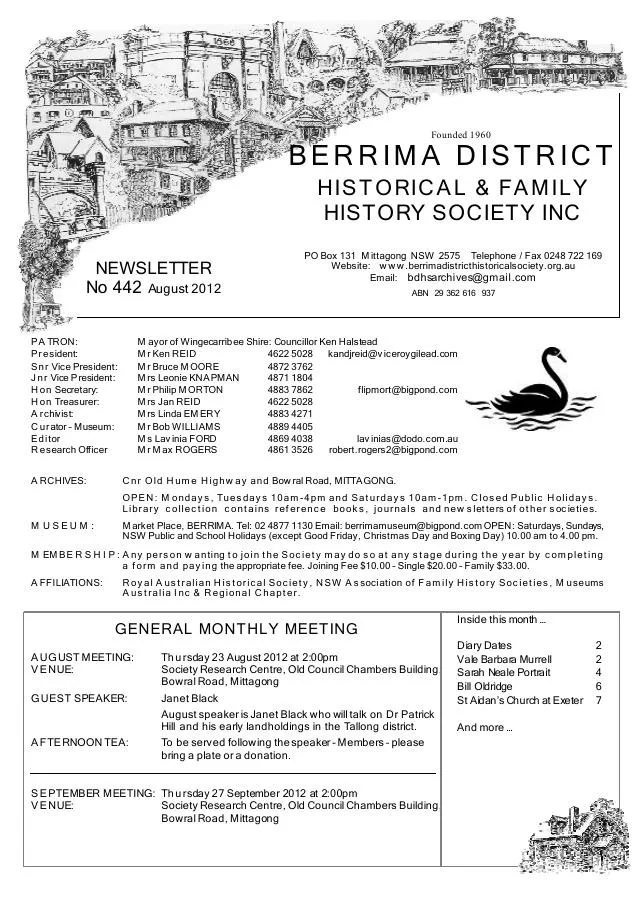
August 2012
- A history of St Aidan’s follows Exeter’s Vine Lodge subdivision, the church’s 1896 dedication, later enlargement and memorials (p.7).
Books in our Library
These catalogue titles mention Exeter. Check the linked catalogue and ask the Society about access.
- Concrite Quarries Pty Ltd. Exeter Quarry Extension Environmental Impact Statement. 1999. Prepared By: R. W. Corkery & - catalogue p. 19
- Exeter Public School Centenary 1891 - 1991 - catalogue p. 23
- Exeter Quarry Extension. Specialist Consultant Studies Volume 1, Parts 1 to 9, 1999 and Volume 2, Parts 10 to 17, 1999. - catalogue p. 23
- Exeter Railway Disaster. A compilation of photos and information. (2014) - catalogue p. 23
- Exploring Exeter (1998) - catalogue p. 23 A history of Exeter and its built environment. The Society later described a revised 2020 edition with additional photographs; check which edition you are consulting. Description source
Find Society publications mentioning Exeter. The list is from October 2026; contact the Society about current availability.
Further research
There is more to discover about Exeter in the Society’s archives and in other collections. A catalogue entry may lead to material that has not been digitised or needs to be consulted in person.
- Ask the Society’s research centre about local files, photographs and records.
- State Library of NSW collections - search photographs, maps, manuscripts and local publications.
- NSW Historical Land Records Viewer - search historical land records, plans and parish maps by place or parcel.
Sources already connected with this place include:
- Wingecarribee heritage evidence
- Heritage NSW: Exeter Railway Station group and village history
- State Library of NSW: Camden County subdivision plans
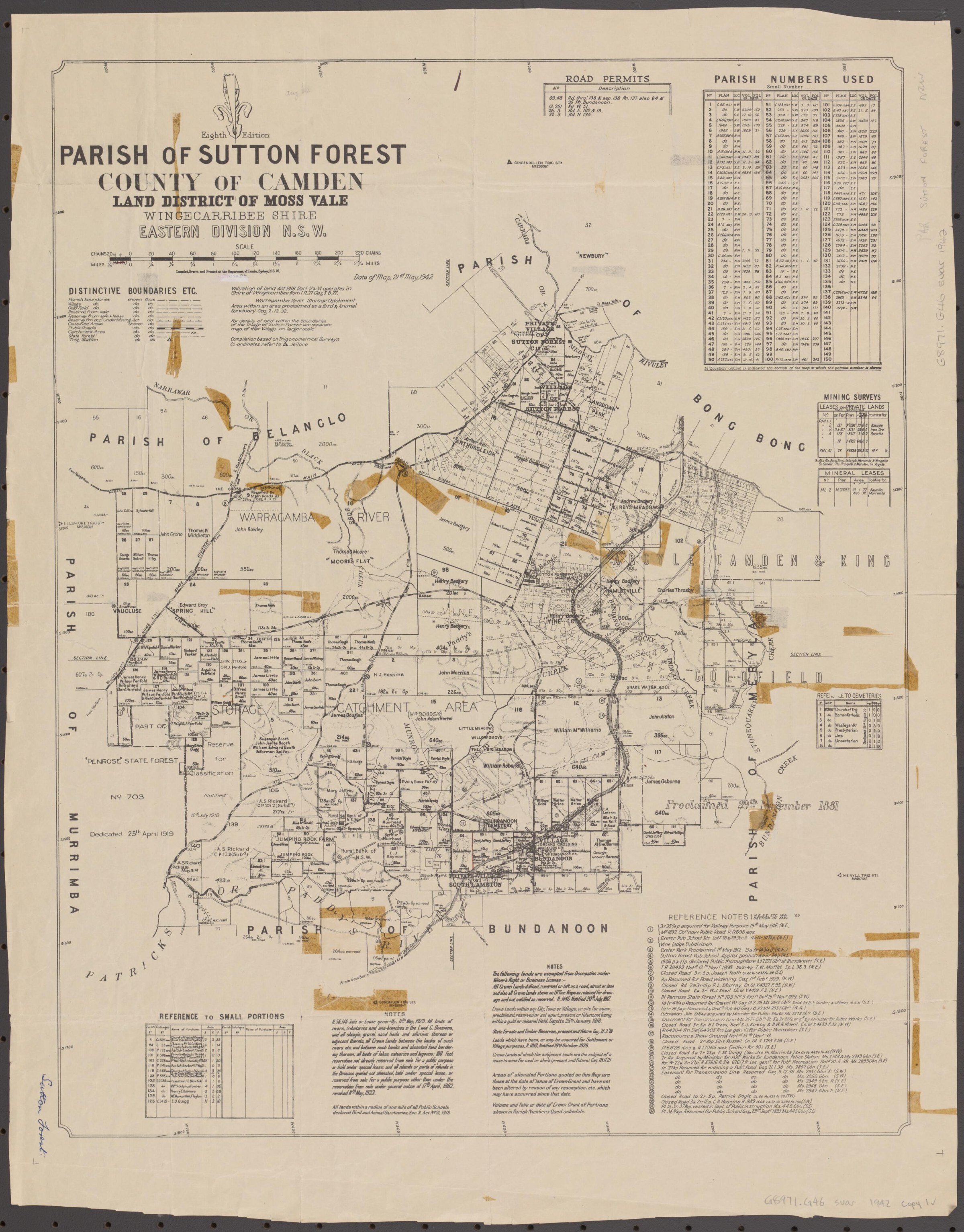
- Parish of Sutton Forest, eighth edition, 1942, National Library of Australia
The Society can undertake professional research at $40 per hour. Contact the research centre to discuss your question and request a quote.