May 2023
Contents
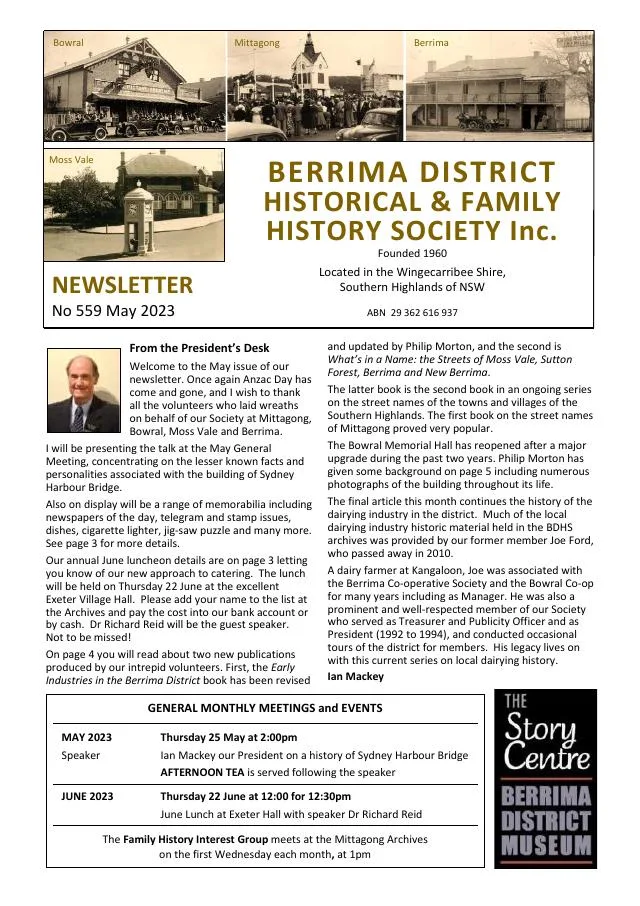
- President’s column and Society news - page 1ANZAC commemorations, new local-history publications, the Bowral Memorial Hall and Joe Ford’s dairying research.
- Bowral Memorial Hall photograph and notices - page 2A photograph of the 1926 opening of the hall’s extensions, with Society notices and Bruce Moore’s column.
- Sydney Harbour Bridge and Exeter luncheon - page 3Introduces Ian Mackey’s presentation on the bridge and historian Richard Reid’s talk on Governor Belmore.
- New Society publications - page 4An updated Early Industries in the Berrima District and a street-name history for Moss Vale, Sutton Forest, Berrima and New Berrima.
- Bowral Memorial Hall through time - page 5Philip Morton uses photographs to follow the School of Arts building from 1884 through extensions and later refurbishments.
- Local dairying: early farms and refrigeration - page 6The beginning of the dairy industry and Thomas Mort’s plans for transporting fresh milk to Sydney; the series draws on Joe Ford’s research.
- Milk trains and the Mittagong butter factory - page 7Fresh Food and Ice Company transport from 1876, farmers’ milk deliveries and the early Mittagong factory, with a continuation in later issues.
- Society information and office bearers - page 8Contact, opening and committee details as printed in May 2023; they may have changed.
Issue highlights
- Ian Mackey's Sydney Harbour Bridge talk is announced (p.3).
- The annual luncheon at Exeter Hall is reported, with Dr Richard Reid as guest (p.3).
- The issue records the Society's mid-year gathering at Exeter (p.3).
- Two publications cover early industries and the origins of street names in Moss Vale, Sutton Forest, Berrima and New Berrima (p.4).
- Photographs follow Bowral Memorial Hall from its School of Arts origins through later alterations (p.5).
- The second dairying instalment follows early farming, refrigerated rail transport and the Mittagong butter factory (pp.6-7).
Original Society source
Explore places in this issue
Follow places named in the contents into their local histories.
Keep exploring