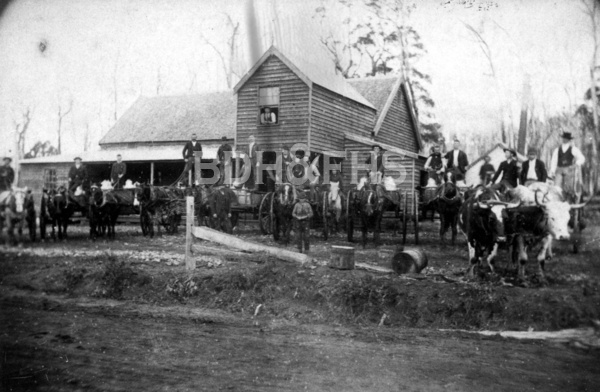
Discover East Kangaloon
Schools, farming, stores and a mutual-improvement society shaped East Kangaloon’s nineteenth-century community.
Explore nearby and connected places: Kangaloon · Robertson · Glenquarry · Wildes Meadow
East Kangaloon through time
Settlement, church and school
The eastern and western Kangaloon settlements took their names from a parish surveyed in the Yarrawa Brush country in 1862. Council’s heritage account describes an agricultural district in which clearing, grass planting, potatoes and dairying expanded during the 1860s. By 1870 East Kangaloon had a store associated with the Alcorn family, and a Mutual Improvement Society with thirty members met at its school.[7]
Older records can place the two Kangaloon communities under different names. The Society’s introduction to Bernadette Mahony’s Kangaloon Footprints says that until 1891 today’s Kangaloon was known as West Kangaloon, while Kangaloon referred to today’s East Kangaloon. The distinction matters when following families, schools and farms through nineteenth-century records.[16]
The NSW Department of Education’s historical dataset records a public school from 1868 and notes that the name Kangaloon (1) was used until 1887. Later closures, reopening and changes of classification show that a country school’s history was not always continuous. The dataset records the final public-school period ending in May 1969. School records and the community organisations around them provide a route into the stories of individual families.[8]
The first St Matthew’s church was also a community building. Council’s 2023 evidence sheet, drawing on Bernadette Mahony’s Kangaloon Footprints, describes a slab church and school built by residents around 1868. The same account says Presbyterian worshippers also used the building. Rev. Julian Henry Rowsell came from Dapto to minister in the district for part of each month. A later church replaced the first building; the former church is now a private residence.[9]
The Alcorn family’s farming story extends beyond the early store. Council’s 2024 heritage peer review describes a property associated with original landholder Robert Alcorn and later family members as evidence of early East Kangaloon settlement and dairying. For a wider collection of photographs, records and recollections, the Society’s library catalogue lists Kangaloon Footprints, published in 2013.[12]
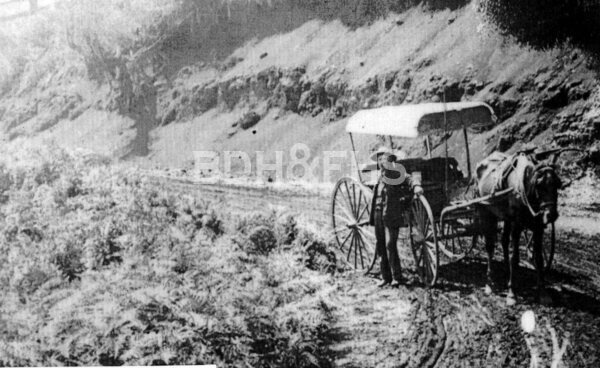
Timber, dairying and families
The 1889 opening of Seery, Hayter & Co’s steam sawmill was celebrated at a picnic near the Nepean River. Philip Morton’s Society article reproduces a contemporary Scrutineer report describing the journey through the district and the mill setting. The partners later moved their operation to Mount Murray, linking the timber history of the two localities.[15]
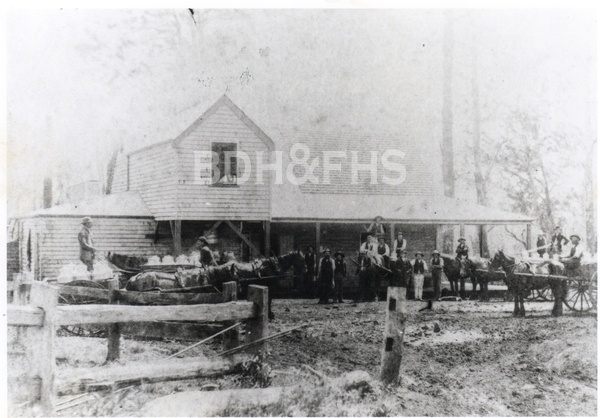
The Society’s July 2020 newsletter identifies Arthur Pritchett as manager of the Waratah butter factory and describes it as being at East Kangaloon, operating from 1891. A later Society dairy history instead places Waratah at West Kangaloon (now Kangaloon) and dates it to 1890. The location and opening date therefore need checking against contemporary records; the 2020 article includes a photograph and family history.[13][14]
The factory photographs belong to a wider dairying network. The Society’s history describes small, jointly owned butter factories at East Kangaloon and other eastern districts, where farmers farther from the railway depended on butter rather than sending fresh milk directly to Sydney. In 1895 farmers formed the Berrima District Farm & Dairy Company to coordinate production and marketing.[17]
East Kangaloon’s cemetery is a valuable family-history lead, although a transcription is an index rather than a substitute for burial registers or the original headstone. Frances Cashman’s 2005-07 photographic transcription lists names including Alcorn, Brooker and Kirkland. A 1903 answer in NSW parliamentary papers records a request to discontinue burials on the church, school and parsonage land because of concerns about Sydney’s water supply; that answer documents an administrative decision at the time, not a complete history of the cemetery.[10][11]
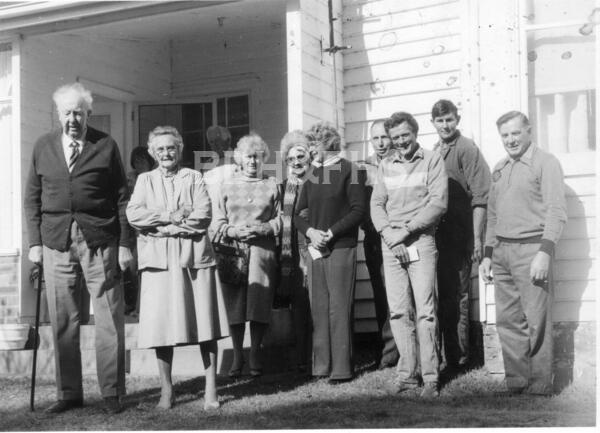
Local historian Bernadette Mahony followed the district’s paper trails into an unexpected sporting connection: Don Bradman’s mother, Emily Whatman, was born at nearby Glenquarry, while his father’s family had farmed in the district before moving to Cootamundra. Mahony’s Kangaloon Footprints brings together photographs, records and recollections from Kangaloon, East Kangaloon, Mount Murray and Boxvale, giving family researchers a starting point for exploring those communities.[18]
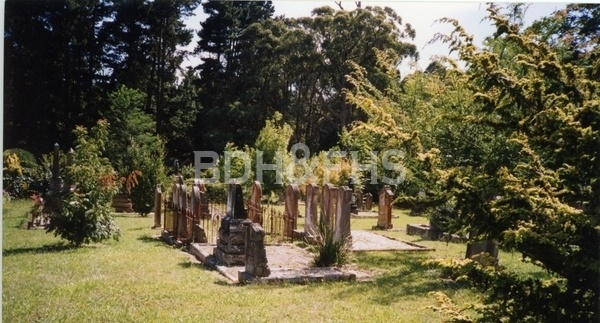
Related historical names and search terms: Kangaloon East, Kangaloon (1). These may name a former settlement, institution or nearby feature; check the context in the sources.
Browse local photographs linked to East Kangaloon
Explore the Society’s photographs for sale
Read the landscape
Edition date unconfirmed
View the annotated map extract on PDF page 7; the original edition has not yet been identified.
East Kangaloon parish map: Alcorn selection
The inspected extract shows East Kangaloon, adjacent portions and Robert Alcorn’s 200 acres, outlined on the image by the heritage study. The study identifies the eastern edge as the former Old Kangaloon Road. The full map and edition date still need checking.
Related places: East Kangaloon, Kangaloon
NSW Historical Land Records Viewer extract reproduced in Wingecarribee Community Heritage Study, Kangaloon and East Kangaloon evidence sheets, PDF page 7.
Follow the link to the heritage study; check the original map and study reuse conditions before reproducing.
Browse maps and plans linked to East Kangaloon
Newsletter Mentions
Stories about East Kangaloon in the Society’s newsletters.
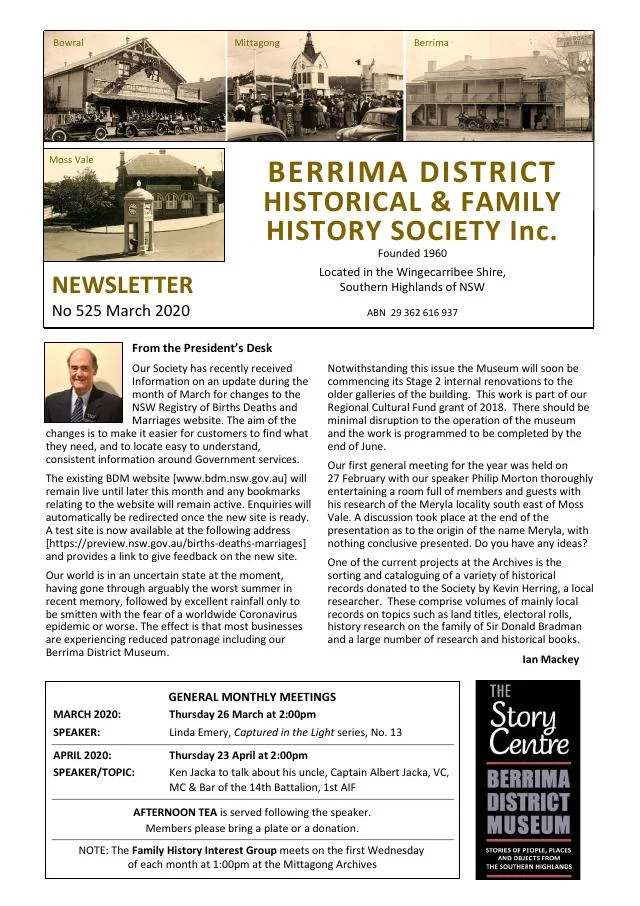
March 2020
- A family recollection of Berrima’s so-called cat burglar precedes a history of the East Kangaloon sawmill and Thomas Seery of Avoca (pp.5-7).
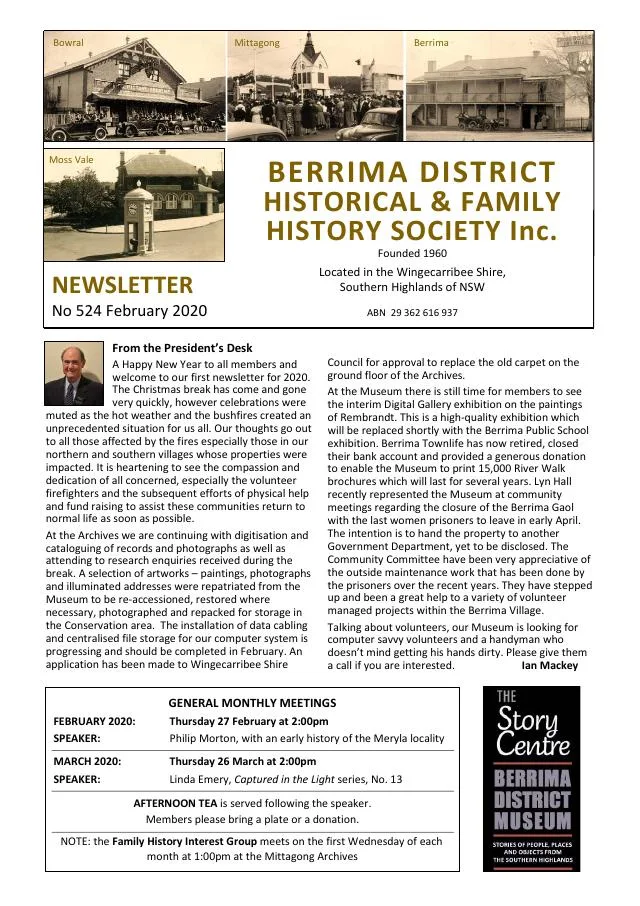
February 2020
- A series on local steam sawmills begins with East Kangaloon, followed by early postcards from the Joe Ford collection (pp.6-7).
Books in our Library
These catalogue titles mention East Kangaloon. Check the linked catalogue and ask the Society about access.
- A History of Education in East Kangaloon - catalogue p. 4
- Kangaloon Footprints: A Collection of Records, Photographs and Anecdotes of Kangaloon, East Kangaloon, Mount Murray a (2013) - catalogue p. 38 Local recorded events, photographs, charts and anecdotes about Kangaloon and its district. Description source
- Register of Admission (B) Public School at East Kangaloon 1897-1910 - catalogue p. 51
Further research
There is more to discover about East Kangaloon in the Society’s archives and in other collections. A catalogue entry may lead to material that has not been digitised or needs to be consulted in person.
- Ask the Society’s research centre about local files, photographs and records.
- State Library of NSW collections - search photographs, maps, manuscripts and local publications.
- NSW Historical Land Records Viewer - search historical land records, plans and parish maps by place or parcel.
Sources already connected with this place include:
- Wingecarribee Heritage Survey 2009: Kangaloon
- NSW Department of Education: historical government-school information
- NSW Parliamentary papers, 1903: question on the East Kangaloon burial ground
- Wingecarribee community heritage study peer review, 2024: Alcorn property
The Society can undertake professional research at $40 per hour. Contact the research centre to discuss your question and request a quote.